- Organisation of African Unity
-
Organization of African Unity
Organization de l'Unité AfricaineInternational organization 1963–2002  →
→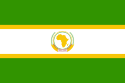
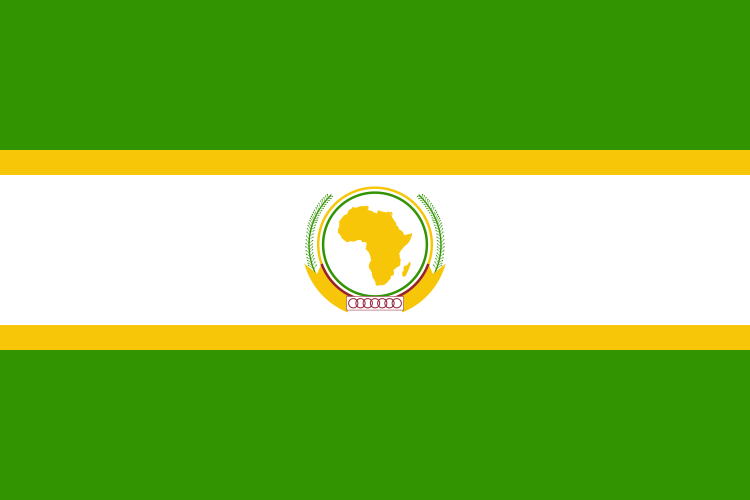
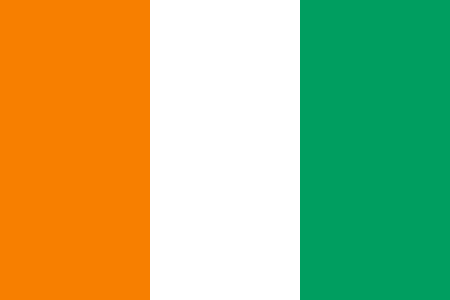
Flag
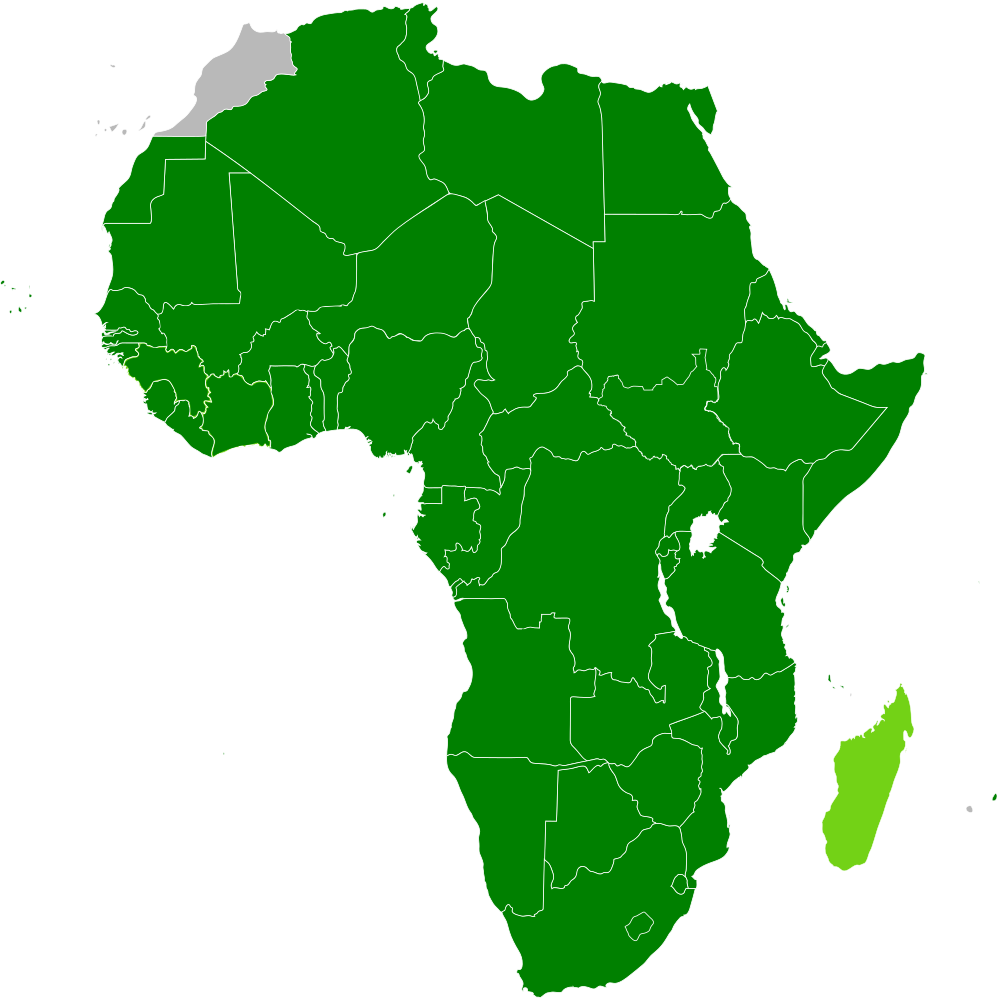
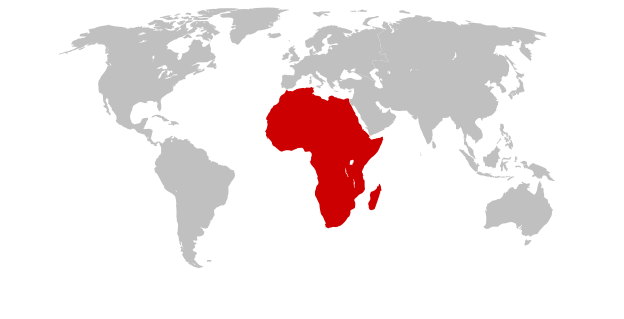
Development of OAU membershipLocation of Organization for African UnityCapital Not applicable¹ Political structure International organization Secretary-general - 1963 - 1964 Kifle Wodajo - 1964 - 1972 Diallo Telli - 1972 - 1974 Nzo Ekangaki - 1974 - 1978 William Eteki - 1978 - 1983 Edem Kodjo - 1983 - 1985 Peter Onu History - Charter 25 May 1963 - Disbanded 9 July 2002 ¹ The headquarters were based in Addis Ababa. The Organisation of African Unity (OAU) (French: Organisation de l'Unité Africaine (OUA)) was established on 25 May 1963. It was disbanded on 9 July 2002 by its last chairperson, South African President Thabo Mbeki, and replaced by the African Union (AU).
Contents
Aims
The OAU had two primary aims:
- To promote the unity and solidarity of the African states and act as a collective voice for the African continent. This was important to secure Africa's long-term economic and political future. Years of colonialism had weakened it socially, politically and economically.[citation needed]
- The OAU was also dedicated to the eradication of all forms of colonialism, as, when it was established, there were several states that had not yet won their independence or were minority-ruled. South Africa and Angola were two such countries. The OAU proposed two ways of ridding the continent of colonialism. Firstly, it would defend the interests of independent countries and help to pursue those of still-colonised ones. Secondly, it would remain neutral in terms of world affairs, preventing its members from being controlled once more by outside powers.
A Liberation Committee was established to aid independence movements and look after the interests of already-liberated states. The OAU also aimed to stay neutral in terms of global politics, which would prevent them from being controlled once more by outside forces – an especial danger with the Cold War.
History of the African Union
This article is part of History of AfricaUnion of African States Organisation of African Unity African Economic Community Sirte Declaration Constitutive Act of the African Union Union Launch
the African Union Portal
v · human rights.- Raise the living standards of all Africans.
- Settle arguments and disputes between members – not through fighting but rather peaceful and diplomatic negotiation.
Soon after achieving independence, a number of African states expressed a growing desire for more unity within the continent. Not everyone was agreed on how this unity could be achieved, however, and two opinionated groups emerged in this respect:
- The Casablanca bloc, led by Kwame Nkrumah of Ghana, wanted a federation of all African countries. Aside from Ghana, it comprised also Algeria, Guinea, Morocco, Egypt, Mali and Libya. Founded in 1961, its members were described as "progressive states".
- The Monrovian bloc, led by Senghor of Senegal, felt that unity should be achieved gradually, through economic cooperation. It did not support the notion of a political federation. Its other members were Nigeria, Liberia, Ethiopia and most of the former French colonies.
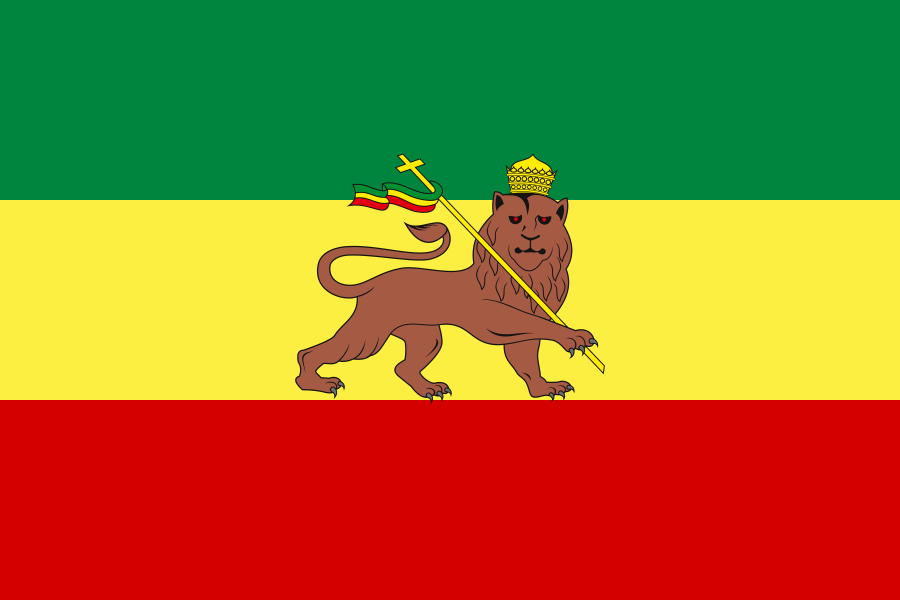
Some of the initial discussions took place at Sanniquellie, Liberia. The dispute was eventually resolved when Ethiopian emperor Haile Selassie I invited the two groups to Addis Ababa, where the OAU and its headquarters were subsequently established. The Charter of the Organisation was signed by 32 independent African states.
At the time of the OAU's disbanding, 53 out of the 54 African states were members; Morocco left on 12 November 1984 following the admission of the Sahrawi Arab Democratic Republic as the government of Western Sahara in 1982.
The organisation was widely derided as a bureaucratic "talking shop" with little power. It struggled to enforce its decisions, and its lack of armed force made intervention exceedingly difficult. Civil wars in Nigeria and Angola continued unabated for years, and the OAU could do nothing to stop them.
The policy of non-interference in the affairs of member states also limited the effectiveness of the OAU. Thus, when human rights were violated, as in Uganda under Idi Amin in the 1970s, the OAU was powerless to stop them.
The Organisation was praised by Ghanaian former United Nations Secretary-General Kofi Annan for bringing Africans together. Nevertheless, in its 39 years of existence, critics argue that the OAU did little to protect the rights and liberties of African citizens from their own political leaders, often dubbing it as a "Dictators' Club"[1] or "Dictator's Trade Union".[2]
The OAU was, however, successful in some respects. Many of its members were members of the UN, too, and they stood together within the latter organisation to safeguard African interests – especially in respect of lingering colonialism. Its pursuit of African unity, therefore, was in some ways successful.
Total unity was difficult to achieve, however, as the OAU was largely divided. The former French colonies, still dependent on France, had formed the Monrovia Group, and there was a further split between those that supported the USA and those that supported the USSR in the Cold War of ideologies. The pro-Socialist faction was led by Kwame Nkrumah, while Félix Houphouët-Boigny of the Ivory Coast led the pro-capitalists. Because of these divisions, it was difficult for the OAU to take action against states involved in internal conflicts because it could rarely reach an agreement on what was to be done.
The OAU did, however, play a pivotal role in eradicating colonialism and minority rule in Africa. It gave weapons, training and military bases to colonised nations fighting for independence or majority rule. Groups such as the ANC and PAC, fighting apartheid, and ZANU and ZAPU, fighting for the independence of Southern Rhodesia, were aided in their endeavours by the OAU. African harbours were closed to the South African government, and South African aircraft were prohibited from flying over the rest of the continent. The UN was convinced by the OAU to expel South Africa from bodies such as the World Health Organisation.
The OAU also worked with the UN to ease refugee problems. It set up the African Development Bank for economic projects intended to make Africa financially stronger. Although all African countries eventually won their independence, it remained difficult for them to become totally independent of their former colonisers. There was often continued reliance on the former colonial powers for economic aid, which often came with strings attached: loans had to be paid back at high interest-rates, and goods had to be sold to the aiders at low rates.
The USA and USSR intervened in post-colonial Africa in pursuit of their own objectives. Help was sometimes provided in the form of technology and aid-workers. While useful, such external assistance was often perceived[who?] as not necessarily in the best interests of the former colonies.
Autonomous specialised agencies, working under the auspices of the OAU, were:
- Pan-African Telecommunications Union (PATU)
- Pan-African Postal Union (PAPU)
- Pan-African News Agency (PANA)
- Union of African National Television and Radio Organisations (URTNA)
- Union of African Railways (UAR)
- Organisation of African Trade Union Unity (OATUU)
- Supreme Council for Sports in Africa
List of Chairpersons
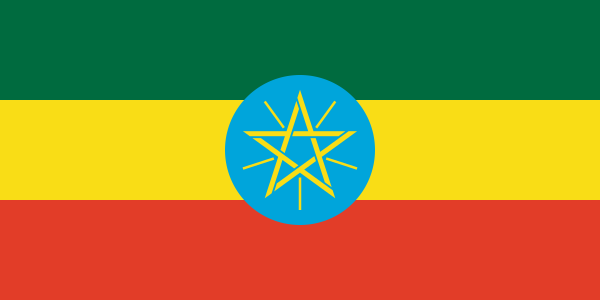
Chairpersons of the Organisation of African Unity Name Beginning of Term End of Term Country Haile Selassie I 25 May 1963 17 July 1964  Ethiopia
Gamal Abdel Nasser 17 July 1964 21 October 1965  Egypt
EgyptKwame Nkrumah 21 October 1965 24 February 1966  Ghana
GhanaJoseph Arthur Ankrah 24 February 1966 5 November 1966 GhanaHaile Selassie I 5 November 1966 11 September 1967 EthiopiaJoseph-Désiré Mobutu 11 September 1967 13 September 1968  Congo (Kinshasa)
Houari Boumedienne 13 September 1968 6 September 1969  Algeria
Ahmadou Ahidjo 6 September 1969 1 September 1970  Cameroon
Kenneth Kaunda 1 September 1970 21 June 1971  Zambia
Moktar Ould Daddah 21 June 1971 12 June 1972  Mauritania
Hassan II 12 June 1972 27 May 1973  Morocco
Yakubu Gowon 27 May 1973 12 June 1974  Nigeria
Siad Barre 12 June 1974 28 July 1975  Somalia
Idi Amin 28 July 1975 2 July 1976  Uganda
Seewoosagur Ramgoolam 2 July 1976 2 July 1977  Mauritius
Omar Bongo 2 July 1977 18 July 1978  Gabon
GabonGaafar Nimeiry 18 July 1978 12 July 1979  Sudan
SudanWilliam R. Tolbert, Jr. 12 July 1979 12 April 1980  Liberia
Léopold Sédar Senghor (acting) 28 April 1980 1 July 1980  Senegal
Siaka Stevens 1 July 1980 24 June 1981  Sierra Leone
Daniel arap Moi 24 June 1981 6 June 1983  Kenya
KenyaMengistu Haile Mariam 6 June 1983 12 November 1984  Ethiopia
Julius Nyerere 12 November 1984 18 July 1985  Tanzania
Abdou Diouf 18 July 1985 28 July 1986 SenegalDenis Sassou-Nguesso 28 July 1986 27 July 1987  Congo (Brazzaville)
Kenneth Kaunda 27 July 1987 25 May 1988 ZambiaMoussa Traoré 25 May 1988 24 July 1989  Mali
MaliHosni Mubarak 24 July 1989 9 July 1990  Egypt
EgyptYoweri Museveni 9 July 1990 3 June 1991 UgandaIbrahim Babangida 3 June 1991 29 June 1992 NigeriaAbdou Diouf 29 June 1992 28 June 1993 SenegalHosni Mubarak 28 June 1993 13 June 1994 EgyptZine El Abidine Ben Ali 13 June 1994 26 June 1995  Tunisia
Meles Zenawi 26 June 1995 8 July 1996  Ethiopia
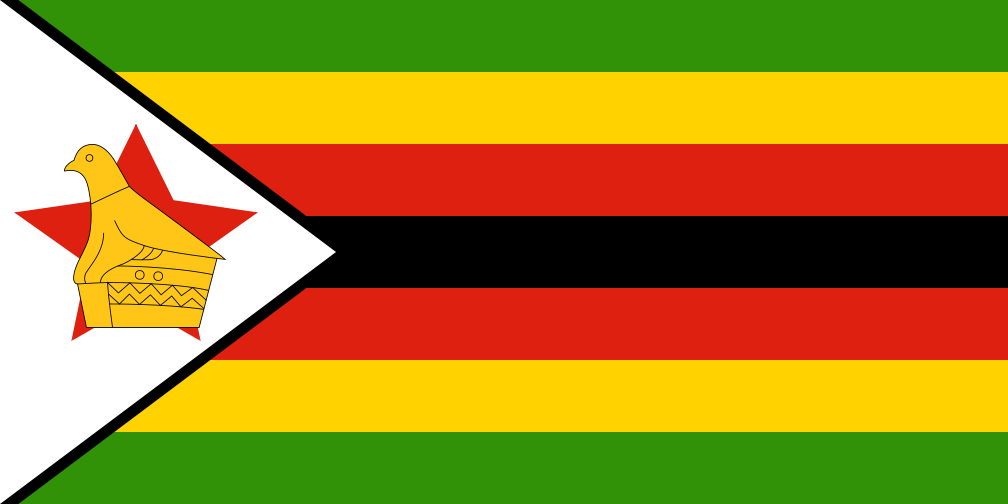
Paul Biya 8 July 1996 2 June 1997 CameroonRobert Mugabe 2 June 1997 8 June 1998  Zimbabwe
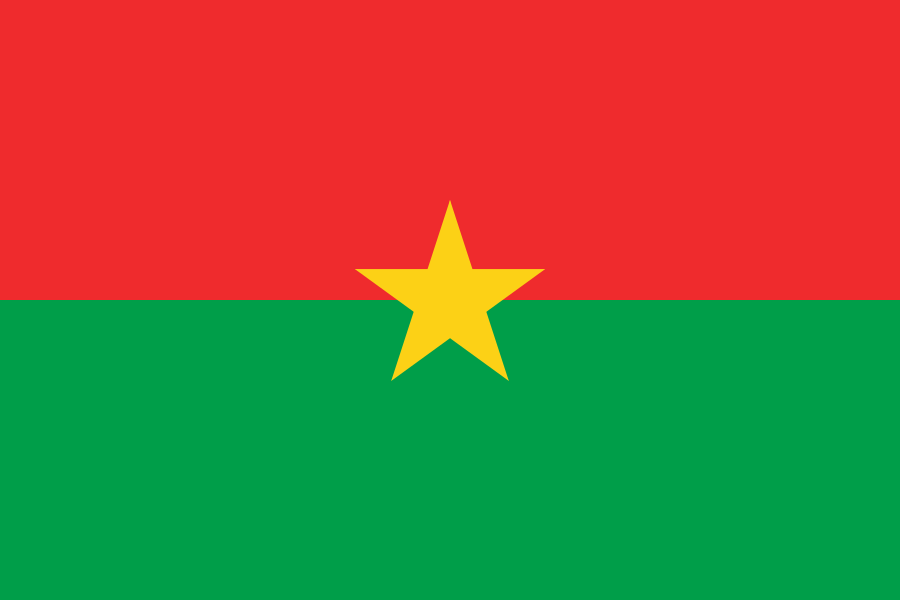
Blaise Compaoré 8 June 1998 12 July 1999  Burkina Faso
Abdelaziz Bouteflika 12 July 1999 10 July 2000 AlgeriaGnassingbé Eyadéma 10 July 2000 9 July 2001  Togo
TogoFrederick Chiluba 9 July 2001 2 January 2002 ZambiaLevy Mwanawasa 2 January 2002 9 July 2002 ZambiaList of Secretaries-general
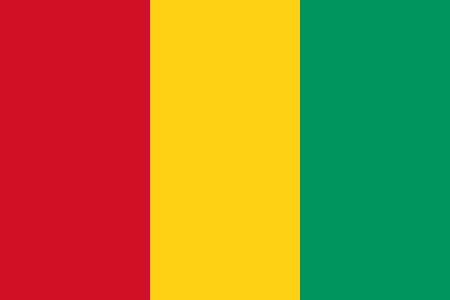
Secretaries-general of the OAU[3] Name Beginning of Term End of Term Country Kifle Wodajo (acting) 25 May 1963 21 July 1964 EthiopiaDiallo Telli 21 July 1964 15 June 1972  Guinea
Nzo Ekangaki 15 June 1972 16 June 1974 CameroonWilliam Eteki 16 June 1974 21 July 1978 CameroonEdem Kodjo 21 July 1978 12 June 1983 TogoPeter Onu 12 June 1983 20 July 1985 NigeriaIde Oumarou 20 July 1985 19 September 1989  Niger
NigerSalim Ahmed Salim 19 September 1989 17 September 2001 TanzaniaAmara Essy 17 September 2001 9 July 2002  Côte d'Ivoire
OAU Summits
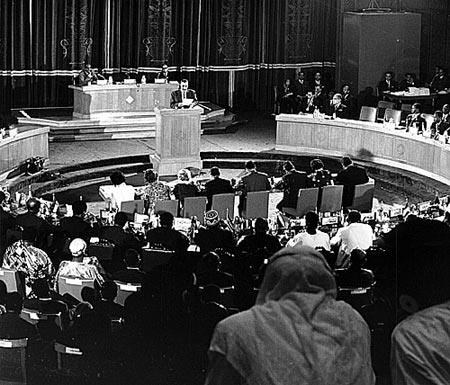
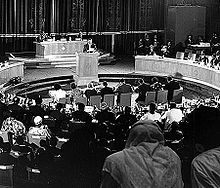 Egypt´s president Nasser at the Cairo summit 1964
International opposition
to apartheid in South AfricaCampaigns Academic boycott · Sporting boycott
Disinvestment ·Constructive engagementInstruments and legislation UN Resolution 1761 (1962)
Crime of Apartheid Convention (1973)
Gleneagles Agreement (1977)
Sullivan Principles (1977)
Comprehensive Anti-Apartheid Act (1986)Organisations Anti-Apartheid Movement
UN Special Committee against Apartheid
Artists United Against Apartheid
Halt All Racist Tours
Organisation of African UnityConferences 1964 Conference for Economic Sanctions
1978 World Conference against RacismUN Security Council Resolutions Resolution 181 · Resolution 191
Resolution 282 · Resolution 418
Resolution 435 · Resolution 591Other aspects Elimination of Racism Day
Biko (song) · Activists
Nelson Mandela 70th Birthday Tribute
Equity television programming banThis box: view · talk · edit It includes ordinary and extraordinary summits.
- Addis Ababa (Ethiopia) : 22–25 May 1961.
- Cairo (Egypt) : 17–21 July 1964.
- Accra (Ghana) : 21–26 October 1965.
- Addis Ababa (Ethiopia) : 5–9 November 1966.
- Kinshasa (Democratic Republic of the Congo, formerly Zaire) : 11–14 September 1967.
- Algiers (Algeria) : 13–16 September 1968.
- Addis Ababa (Ethiopia) : 6–10 September 1969.
- Addis Ababa (Ethiopia) : 1–3 September 1970.
- Addis Ababa (Ethiopia) : 21–23 June 1971.
- Rabat (Morocco) : 12–15 June 1972.
- Addis Ababa (Ethiopia) : 27–28 May 1973.
- Kampala (Uganda) : 28 July – 1 August 1975.
- Port Louis (Mauritius) : 2–6 July 1976.
- Libreville (Gabon) : 2–5 July 1977.
- Khartoum (Sudan) : 18–22 July 1978.
- Monrovia (Liberia) : 17–20 July 1979.
- Freetown (Sierra Leone) : 1–4 July 1980.
- Nairobi (Kenya) : 24–27 June. 1981.
- Addis Ababa (Ethiopia) : 6–12 June 1983.
- Addis Ababa (Ethiopia) : 12–15 November 1984.
- Addis Ababa (Ethiopia) : 18–20 July 1985.
- Addis Ababa (Ethiopia) : 28–30 July 1986.
- Addis Ababa (Ethiopia) : 27–29 July. 1987.
- Addis Ababa (Ethiopia), Extraordinary Summit : Oct. 1987.
- Addis Ababa (Ethiopia) : 25–28 May 1988.
- Addis Ababa (Ethiopia) : 24–26 July 1989.
- Addis Ababa (Ethiopia) : 9–11 July 1990.
- Abuja (Nigeria) : 3–5 July 1991.
- Dakar (Senegal) : 29 June – 1 July 1992.
- Cairo (Egypt) : 28–30 June 1993.
- Tunis (Tunisia) : 13–15 June 1994.
- Addis Ababa (Ethiopia) : 26–28 June 1995.
- Yaoundé (Cameroon) : 8–10 June 1996.
- Harare (Zimbabwe) : 2–4 June 1997.
- Ouagadougou (Burkina Faso) : 8–10 June 1998.
- Algiers (Algeria) : 12–14 July 1999.
- Sirte (Libya), Extraordinary Summit : 6–9 September 1999.
- Lomé (Togo) : 10–12 July 2000.
- Lusaka (Zambia) : 9–11 July 2001, the last OAU summit.
OAU members by date of admission (53 states)
- 25 May 1963 :
- Algeria, Burundi, Cameroon, Central African Republic, Chad, Congo (Brazzaville), Congo (Léopoldville).[4] Dahomey,[5] Egypt, Ethiopia, Gabon, Ghana, Guinea, Ivory Coast,[6] Liberia, Libya, Madagascar,[7] Mali, Mauritania,[8] Morocco,[9] Niger, Nigeria, Rwanda, Senegal, Sierra Leone, Somalia, The Sudan, Tanganyika,[10] Togo,[11] Tunisia, Uganda, Upper Volta,[12] Zanzibar[10]
- 13 December 1963:
- 13 July 1964:
- Malawi
- 16 December 1964:
- Zambia
- Oct 1965 :
- The Gambia
- 31 October 1966:
- Botswana, Lesotho
- Aug 1968 :
- Mauritius
- 24 September 1968:
- Swaziland
- 12 October 1968:
- Equatorial Guinea
- 19 November 1973:
- Guinea-Bissau
- 11 February 1975:
- Angola
- 18 July 1975:
- Cape Verde, Comoros, Mozambique, São Tomé and Príncipe
- 29 June 1976:
- Seychelles
- 27 June 1977:
- Djibouti
- June 1980:
- Zimbabwe
- 22 February 1982:
- Saharan Arab Democratic Republic (Western Sahara)
- June 1990:
- Namibia
- 24 May 1993:
- Eritrea
- 6 June 1994:
- South Africa
- ?
See also
- Bamako Convention
- Casablanca Group
- MPAIAC
- Pan-Africanism
- List of Linguistic Rights in Constitutions (Africa)
References
- ^ News.bbc.co.uk
- ^ Somalilandtimes.net
- ^ African Union official site: Former Secretaries General of the OAU
- ^ 1966-71 and from 1997 Congo (Kinshasa); 1971-97 Zaire.
- ^ From 1975 Benin.
- ^ From 1985 Côte d'Ivoire.
- ^ Suspended December 2001 - 10 July 2003.
- ^ Suspended 4 August 2005.
- ^ Withdrew 12 November 1984.
- ^ a b Tanganyika and Zanzibar merged 26 April 1964 to form the United Republic of Tanganyika and Zanzibar, which was renamed Tanzania 1 November 1964.
- ^ Suspended from 25 February 2005.
- ^ From 1984 Burkina Faso.
- ^ "Palestinian Economy - Country: Land, pPeople and Government". United Nations Conference on Trade and Development (UNCTAD). http://r0.unctad.org/palestine/economy1.htm. Retrieved 2009-07-28.
Further reading
- "OAU After Twenty Years"; Pub. Praeger; ISBN 0-03-062473-8; (May 1984)
- "Africa's First Peacekeeping Operation: The OAU in Chad, 1981-1982" by Terry M. Mays, Pub. Praeger; ISBN 0-275-97606-8; (April 30, 2002)
- "African Exodus: Refugee Crisis, Human Rights, & the 1969 OAU Convention" by Chaloka Beyani, Chris Stringer, Pub. Lawyers Committee for Human Rights; ISBN 0-934143-73-0; (July 1995)
- CEC.rwanda2.free.fr, Report on the Rwandan Genocide in 2000.
- Black-king.net, Emperor Haile Selassie I speaks at the OAU conference, Addis Ababa, 1963
Categories:- Politics of Africa
- Addis Ababa
- Accra
- Former international organizations
- Organizations established in 1963
- Organizations disestablished in 2002
Wikimedia Foundation. 2010.
Look at other dictionaries:
Organisation of African Unity — noun → African Union. Usage: The spelling isation used above is in line with standard Australian practice. However, the official English language name of this body was spelt with ization. See note at ise1 …
Organization of African Unity — [ɔːgənaɪ zeɪʃn əv æfrɪkən juːnɪtɪ, englisch], Abkürzung OAU, französische Organisation de l Unité Africaine [ɔrganiza sjɔ̃ də lyni te afri kɛːn], Abkürzung OUA, deutsch Organisation für Afrikanische Einheit, Abkürzung OAE, 1963 gegründete und… … Universal-Lexikon
African Union — الاتحاد الأفريقي (Arabic) … Wikipedia
African Development Bank — AfDB logo Formation August 4, 1963 Type International organization Legal status Treaty Purpose/focus … Wikipedia
Organisation de l'Unité Africaine — Pour les articles homonymes, voir OUA (homonymie). Organisation de l unité africaine Entrée chronologique des pays dans l OUA … Wikipédia en Français
Organisation de l'unite africaine — Organisation de l unité africaine Pour les articles homonymes, voir OUA (homonymie). Organisation de l unité africaine Entrée chronologique des pays dans l OUA … Wikipédia en Français
Organisation de l’Unité Africaine — Organisation de l unité africaine Pour les articles homonymes, voir OUA (homonymie). Organisation de l unité africaine Entrée chronologique des pays dans l OUA … Wikipédia en Français
Organisation de l’unité africaine — Organisation de l unité africaine Pour les articles homonymes, voir OUA (homonymie). Organisation de l unité africaine Entrée chronologique des pays dans l OUA … Wikipédia en Français
Organisation of Islamic Cooperation — OIC redirects here. For other uses, see OIC (disambiguation). Organisation of Islamic Cooperation … Wikipedia
African independence movements — The African Independence Movements took place in the 1960s, when a wave of struggles for independence in African colonies was witnessed. These independence movements took place in countries like Angola, Guinea Bissau, Mozambique, and South Africa … Wikipedia
 18+© Academic, 2000-2026
- Contact us: Technical Support, Advertising
Dictionaries export, created on PHP, Joomla, Drupal, WordPress, MODx.Share the article and excerpts
Organisation of African Unity
- Organisation of African Unity
-
Organization of African Unity
Organization de l'Unité AfricaineInternational organization 1963–2002 →Flag
Development of OAU membershipLocation of Organization for African UnityCapital Not applicable¹ Political structure International organization Secretary-general - 1963 - 1964 Kifle Wodajo - 1964 - 1972 Diallo Telli - 1972 - 1974 Nzo Ekangaki - 1974 - 1978 William Eteki - 1978 - 1983 Edem Kodjo - 1983 - 1985 Peter Onu History - Charter 25 May 1963 - Disbanded 9 July 2002 ¹ The headquarters were based in Addis Ababa. The Organisation of African Unity (OAU) (French: Organisation de l'Unité Africaine (OUA)) was established on 25 May 1963. It was disbanded on 9 July 2002 by its last chairperson, South African President Thabo Mbeki, and replaced by the African Union (AU).
Contents
Aims
The OAU had two primary aims:
- To promote the unity and solidarity of the African states and act as a collective voice for the African continent. This was important to secure Africa's long-term economic and political future. Years of colonialism had weakened it socially, politically and economically.[citation needed]
- The OAU was also dedicated to the eradication of all forms of colonialism, as, when it was established, there were several states that had not yet won their independence or were minority-ruled. South Africa and Angola were two such countries. The OAU proposed two ways of ridding the continent of colonialism. Firstly, it would defend the interests of independent countries and help to pursue those of still-colonised ones. Secondly, it would remain neutral in terms of world affairs, preventing its members from being controlled once more by outside powers.
A Liberation Committee was established to aid independence movements and look after the interests of already-liberated states. The OAU also aimed to stay neutral in terms of global politics, which would prevent them from being controlled once more by outside forces – an especial danger with the Cold War.
History of the African Union
This article is part of History of AfricaUnion of African States Organisation of African Unity African Economic Community Sirte Declaration Constitutive Act of the African Union Union Launch
the African Union Portal