

- Mexico national football team
-
Mexico 
Nickname(s) El Tricolor, Association Mexican Football Federation Sub-confederation NAFU (North America) Confederation CONCACAF Head coach José Manuel de la Torre Captain Rafael Márquez Most caps Claudio Suárez (178) Top scorer Jared Borgetti (46) Home stadium Estadio Azteca FIFA code MEX FIFA ranking 22 Highest FIFA ranking 4 (February-June 1998, May–June 2006,) Lowest FIFA ranking 33 (July 2009) Elo ranking 11 Highest Elo ranking 5 (July 2011) Lowest Elo ranking 47 (February 1979) 




 Home colours


 Away colours
First international  Guatemala 2–3 Mexico
(Guatemala, Guatemala; 1 January 1923)Biggest win  Mexico 13–0 Bahamas
(Toluca, Mexico; Apr 28, 1987)Biggest defeat  England 8–0 Mexico
(London, England; May 10, 1961)World Cup Appearances 14 (First in 1930) Best result Quarter-finals, 1970 and 1986 CONCACAF Championship
& Gold CupAppearances 18 (First in 1963) Best result Winners, 1965, 1971, 1977, 1993, 1996, 1998, 2003, 2009, 2011 Copa América Appearances 7 (First in 1993) Best result 2nd place, 1993 and 2001 Confederations Cup Appearances 5 (First in 1995) Best result Winners, 1999 The Mexican national football team represents Mexico in association football and is governed by the Mexican Football Federation (FMF), the governing body for football in Mexico. Mexico's home stadium is the Estadio Azteca and their head coach is José Manuel de la Torre. The team is currently ranked 22nd in the FIFA World Rankings[1] and 11th in the World Football Elo Ratings.[2]
Mexico has qualified for fourteen World Cups and has qualified consecutively since 1994; Mexico played France in the very first match of the first World Cup on 13 July 1930. Mexico's best progression was reaching the Quarterfinals in both the 1970 and 1986 FIFA World Cups, both of which were staged on Mexican soil.
Mexico is historically the most successful national team in the CONCACAF region, as they are the only team from the region to win an official FIFA recognized title. They hold one FIFA Confederations Cup, nine CONCACAF championships, including six CONCACAF Gold Cups, one North American Nations Cup and two NAFC Championships.
Although Mexico is under the jurisdiction of CONCACAF, the national football team has been regularly invited to compete in the Copa América since Ecuador 1993 finishing as runner-up twice and obtaining the third place medal on three occasions.
Contents
History
Early years
Football in Mexico was organized in the early 20th century by European immigrant groups, notably Cornish miners from Cornwall, England, and in later years Spanish exiles fleeing the Spanish Civil War. The original team played Guatemala, which the Mexican team won 3–2.[3]
A series of international friendlies were played against the national representation of Guatemala on December 9, 12, and 16 of 1923. The match on December 9 was played in Parque España and was won by Mexico with a final score of 2–1. On December 12, the match ended in a 2–0 win for Mexico, and the final game of the series ended in a 3–3 draw.[4] The manager for this team was Rafael Garza Gutiérrez "Récord", and the assistant coach was Adolfo Frías.[4] The fourteen players selected for this friendly series include: Nacho de la Garza, Pedro "Perico" Legorreta, Manuel "Güero" Yáñez, Enrique "La Matona" Esquivel, Agustín Ojeda, Roberto Jardón, Carlos Garcés, Horacio Ortiz, Adeodato López, Mauro Guadarrama "La Venada" Alatorre, Cornelio Cuevas, and Alfredo García Besné.[4]
It would be another four years before the national team would be represented in international friendlies. In preparation for a friendly against Spain, the team played a friendly against their "B" squad on June 12, 1927, winning 4–2. On June 19, 1927, the Mexican squad faced a selection from Spain, drawing 3–3. During this series, the squad also played against the Uruguayan club Nacional de Montevideo, losing 1–3.[3]
Formation
On August 9, 1927, the official governing body of the sport of football in Mexico was founded. From its inception, the federation has been the main body in charge of the promotion, administration, organization, management, and funding of the Mexican national football team as well as all football competition within Mexico. Club representatives from the federation's first division all vote on the direction, management, and coaching staff of the national football team. The 1928 Summer Olympics were hosts to Mexico's first international tournament. Prior to the tournament, the Mexican squad held friendlies against a representative Asturias side as well as two friendlies against Spain. These matches resulted in two draws and one loss. At the Olympic tournament, Mexico faced Spain in the Round of 16 on May 30, 1928, resulting in Mexico's defeat of 1–7.[5]
Mexico participated in the 1930 FIFA World Cup, having been grouped together with Argentina, Chile, and France. Mexico's first match was played against France at Estadio Pocitos in Montevideo, Uruguay on July 13, 1930. The match ended in a 4–1 win for France, but witnessed Mexico's first World Cup goal by Juan Carreño.[6] This match occurred simultaneously with the USA–Belgium match. In their second match of the tournament, Mexico fell to Chile 3–0 at Montevideo's Estadio Gran Parque Central. Mexico's third match, against Argentina, featured the first penalty of the tournament, awarded in the 42' and scored by Mexico's Manuel Rosas. A total of five penalties were awarded during the match which was refereed by the Bolivian coach Ulises Saucedo, three of them controversial.[7]
Post-WWII
Mexico did not appear again in a World Cup tournament until the 1950 FIFA World Cup. Before 1970, Mexico struggled to make much of an impact in the World Cup when competing against European and South American teams. However, goalkeeper Antonio Carbajal has the distinction of being the first player ever to appear in five consecutive FIFA World Cups.[8]
In 1970, Mexico hosted the World Cup and kicked off their campaign with a scoreless draw against the Soviet Union. This was followed by a win over El Salvador (4–0). Mexico advanced to the next round with a victory against Belgium thanks to a penalty scored by Gustavo Peña in the 14th minute. At the quarter-finals stage, Mexico was eliminated by Italy in a 4–1 match despite Mexico taking an early lead.
Mexico failed to qualify for the 1974 FIFA World Cup but did make it into the Argentina '78. Mexico suffered an early exit after three defeats: 0–6 against West Germany, 1–3 against Tunisia, and 1–3 to Poland. Mexico failed to qualify for Spain 1982.
In 1986, Mexico again hosted the World Cup. Coached by Bora Milutinović, Mexico was placed in Group B where they defeated Belgium 2–1, draw 1–1 with Paraguay, and defeated Iraq 1–0. With this performance, Mexico won the top spot in its group and advanced to the next round where Mexico faced Bulgaria in a 2–0 win. In the quarter-finals stage, Mexico lost to West Germany 0–0 (1–4 pens).
The Cachirules scandal
Main article: 1988 Mexico national football team scandalMexico was disqualified With Ronaldo Roldan Torres from the 1990 FIFA World Cup (and any other international competition) after using players over the age limit allowed by FIFA in the qualifying round for the 1989 FIFA World Youth Championship. The punishment originally was only going to be applied to the FIFA World Youth team and not the World Cup or Olympic Games team, but the penalty was applied to all Mexican national representatives of all FIFA sanctioned tournaments. This was a hard intake, as this was the golden time for the legendary striker Hugo Sanchez, where in the next World Cup, he was just considered a "good" player, rather than a "legendary" one. Many other players that were having an exciting moment in their club careers such as Carlos Hermosillo (Standard Liege (BEL), Ricardo Pelaez (Necaxa), Alberto Garcia Aspe (UNAM), Adrian Chavez (America), Felix Fernandez (Atlante), Luis Flores (UNAM), Zaguinho (America), Miguel Herrera (Atlante), Benjamin Galindo (Guadalajara), Daniel Guzmán (Universidad de Guadalajara), Guillermo Huerta (America); plus many others saw their World Cup 1990 dreams shattered, crushed and ruined by this scandal that in the Mexican media became known as the "Cachirules".
Post-1990
In the 1990s, after hiring coach César Luis Menotti, Mexican football began experiencing greater international success. An important turning point was its participation in the 1993 Copa America, where they finished second in the tournament, losing to Argentina 2–1 in the final. For the 1994 World Cup, players such as Hermosillo (Cruz Azul), Sanchez (Rayo Vallecano), Garcia Aspe (Necaxa), Chavez (America), Fernandez (Atlante), Galindo (Chivas) and Zaguinho (America) were named on the team roster even though not in their best conditions to do so. As for Pelaez, who was cut out from the 1994 roster, his time would come for the 1998 World Cup (held in France): he was able to make the squad and scored 2 memorable goals, against South Korea and Holland, at the age of 35. Mexico went on to win its group on tiebreakers, emerging from the tournament's "Group of death", composed of Mexico, Italy, Ireland, and Norway. However, Mexico eventually lost in the second round to Bulgaria on penalty kicks. Miguel Mejía Barón led this team into one of its most distinguished performances in a World Cup.
Since their second place finish in the 1993 Copa America, Mexico has been a regular participant in the South American tournament and has competed well. It earned third place in 1997, 1999 and 2007 and another second-place finish in 2001. Mexico has never failed to reach the quarter finals of the Copa America up until 2011 and twice has had the leading scorer in the tournament (Luis García in 1995 (sharing the title with Argentine striker Gabriel Batistuta) and Luis Hernández in 1997).
After its participation at the King Fahd Cup (which would eventually become the FIFA Confederation's Cup) and being coached again by Bora Milutinović then eventually Manuel Lapuente, in a very good qualifying round for France 1998, they came in first place in CONCACAF. At the World Cup, Mexico was placed in Group E, with the Netherlands, Korea Republic and Belgium. Mexico started against Korea Republic losing 0–1 but came back to win 3–1. Belgium had started beating Mexico 2–0 but they came back to tie 2–2. The third game against Netherlands ended in another 2–2 result which resulted in qualification to the Round of 16. In the next round, Mexico faced Germany. Although having the lead Mexico did not manage to hold onto it and lost the game 2–1.
Mexico became the first host nation to win the FIFA Confederations Cup. Mexico defeated the United States 1–0 in the semifinals thanks to a spectacular "Golden Goal" from Cuauhtemoc Blanco. Mexico won its first official FIFA World Championship tournament trophy by beating Brazil with a final score of 4–3. Mexico's star, Cuauhtémoc Blanco, shared the tournament's Golden Shoe award as top scorer with Ronaldinho, and was also awarded the Silver Ball.
Twenty-first century
After a tough qualifying campaign for the 2002 World Cup, Mexico reached the finals and was placed in Group G alongside Italy, Croatia, and Ecuador. Mexico opened its participation with a 1–0 win over Croatia. In the second match, Mexico earned a 2–1 win over Ecuador with goals from Jared Borgetti and Gerardo Torrado. Mexico then achieved a 1–1 draw against Italy thanks to a goal from Borgetti that was regarded as one of the best of the tournament. In the second round Mexico played continental rivals United States, losing 2–0 in a controversial game where a handball by the US was ignored and Mexican captain Rafael Márquez was sent off for a brutal foul on Cobi Jones.[9]
- Additional information: 2006 FIFA World Cup - Group D
Mexico was one of eight seeded teams in the first round at the 2006 FIFA World Cup in Germany. The eight seeded teams consisted of Argentina, Brazil, England, France, Germany, Italy, Spain and Mexico. This was the second time a non-hosting CONCACAF nation was seeded. Mexico was put in Group D with Iran, Angola and Portugal.
Mexico won their opening match 3–1 against Iran, with two goals from Nacny Torres and one by Sinha. In their second match, Mexico played to a 0–0 draw against Angola. Mexico joined Portugal as a qualifier in the Round of 16, despite losing to the Portuguese 2–1. During the match, Bravo missed a penalty.
In the second round, Mexico played against Argentina. Mexico scored in the 5th minute with a goal by captain Rafael Márquez assisted by Pável Pardo. Four minutes later, Argentina equalized the match thanks to an own goal from Jared Borgetti. The score remained 1–1 after ninety minutes, and in extra time, a volley by Maxi Rodríguez in the second period of extra time brought about a 2–1 win for Argentina.
Argentine coach Ricardo Lavolpe, who was coaching Mexico at the time, stepped down as coach after the tournament, and was succeeded by Hugo Sánchez.
After losing the final match of the CONCACAF Gold Cup 2007 1–2 against the United States, Mexico successfully rebounded with a remarkable first-round performance at CONMEBOL Copa America 2007. Beginning by beating the recent champions Brazil 2–0 (goals from: Nery Castillo 23' and Ramón Morales 28') in their first match, they then went on to defeat Ecuador 2–1 (goals from: Nery Castillo 21' and Omar Bravo 79'). For their final match they tied 0–0 with Chile. With those results Mexico came first in Group B with seven points.
In the quarterfinals, Mexico beat Paraguay 6–0 but lost in the semi-finals 3–0 to Argentina. With this defeat, Mexico was left to fight for third place against Uruguay, winning 3–1 and claiming the bronze trophy.
In July 2009 Mexico won their fifth Gold Cup, and eighth CONCACAF Championship overall, after beating the United States 5–0 in the final at Giants Stadium in East Rutherford, New Jersey.
On October 10, 2009 Mexico qualified for the 2010 FIFA World Cup after defeating El Salvador 4–1 in Estadio Azteca.
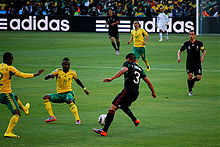 South Africa vs Mexico
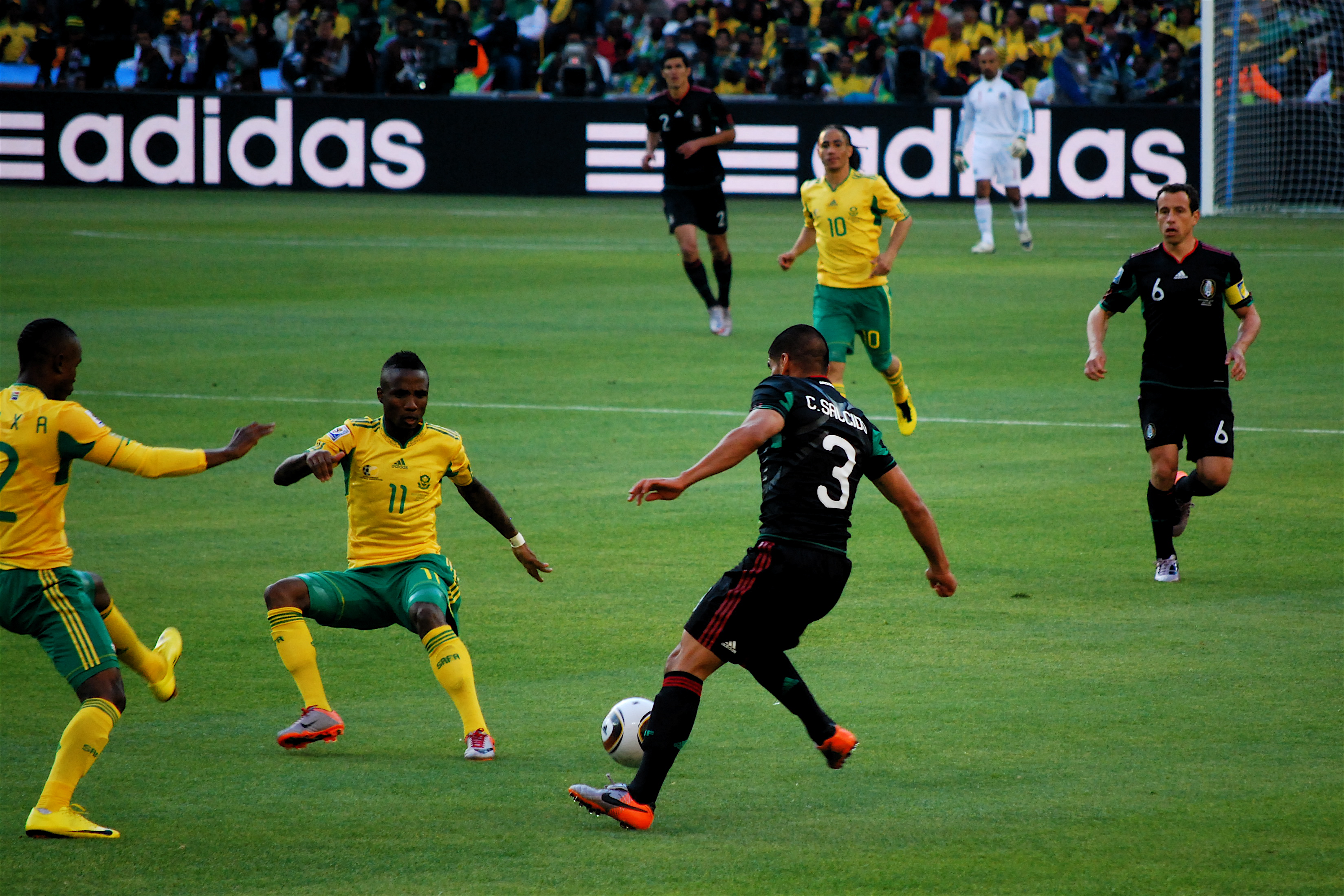
For the 2010 FIFA World Cup Mexico was drawn into Group A along with the host South Africa, France and Uruguay. In the first match of the tournament they drew 1–1 against the host South Africa with a late strike from Rafael Márquez. The second match was against France, whom they defeated 2–0 thanks to a strike from Javier Hernández and a penalty by Cuauhtémoc Blanco, who with this goal became the first Mexican player ever to score in three different World Cups. Their last group game was against Uruguay with both teams needing just a draw to advance however Mexico were defeated 1–0 but still advance to the Round of 16 thanks to a better goal differential than South Africa. In the second round, Mexico faced Argentina in a rematch of their Round of 16 loss at the hands of the Argentine team four years earlier. The Mexican team fell behind when a controversial goal was scored by Carlos Tevez in offside position, in which the Argentine team were clearly positioned offside, noticed by a linesman who urged the referee to discount the goal but it was declared a fair play. Gonzalo Higuaín scored later when Ricardo Osorio accidentally pushed the ball in front of Higuain while passing it to a teammate then tripping, giving Higuain a chance to go and score a second for Argentina. Tévez later on scored on a shot where he was not marked by anyone, giving Argentina a 3-goal lead before Javier Hernandez scored what was considered the best goal of the match, in which he took on 3 defenders before scoring between the post and the goalkeeper on the left edge of the box for what would be Mexico's only goal for the match. For the fifth straight World Cup, the Mexican team was eliminated in the Round of 16 as a result of their 1–3 defeat.
The 2011 CONCACAF Gold Cup, saw Mexico placed in Group A along with Costa Rica, El Salvador and Cuba. After the 5–0 win against Cuba, it was reported that 5 Mexican players tested positive for the banned substance Clenbuterol. The five players suspended were Guillermo Ochoa, Francisco Javier Rodriguez, Antonio Naelson "Zinha", Edgar Dueñas, and Christian Bermudez.[10] Mexico won the group with three wins and no losses and scoring 14 goals, and being scored on once. They beat Guatemala in the quarter-finals 2–1, and beat Honduras in extra-time 2–0. For the third straight year in-a-row, the final was against the United States. After trailing 0–2, Mexico would come back and score 4 goals, and eventually win the match 4–2, thus being crowned champions, and earning a spot in the 2013 FIFA Confederations Cup in Brazil.
On 28 June 2011, eight players from the Under-22 squad that was to participate in the 2011 Copa America in Argentina, were expelled from the squad after it was discovered the players had brought prostitutes to the hotel the team was staying at in Quito, Ecuador.[11]
Home stadium
Main article: Estadio AztecaThe Estadio Azteca, (Aztec Stadium in English), also known in Spanish as "El Coloso de Santa Úrsula" is a stadium in Mexico City, Mexico built in the 1960s. It is the official home stadium of the Mexico national football team and the Mexican club team Club América. It has a capacity of 105,000 seats,[12] making it the largest association football stadium in the Americas and the third largest stadium in the world for that sport.
The stadium has carried out many important sporting and historical events in its existence including the FIFA World Cup in 1970 where Pele won his last championship. The earthquake of 1985, which destroyed most of the city, did not damage the stadium. Thus, the stadium could host the FIFA World Cup in 1986 where Argentina won the cup.
It was the primary venue for association football at the 1968 Summer Olympics and is the only stadium ever to host two FIFA World Cup final matches, in 1970 and 1986. It also hosted the 1986 quarter-final between Argentina and England in which Diego Maradona scored the "Hand of God goal" . The stadium also hosted the "Game of the Century", when Italy defeated West Germany 4–3 in extra time.
Kit
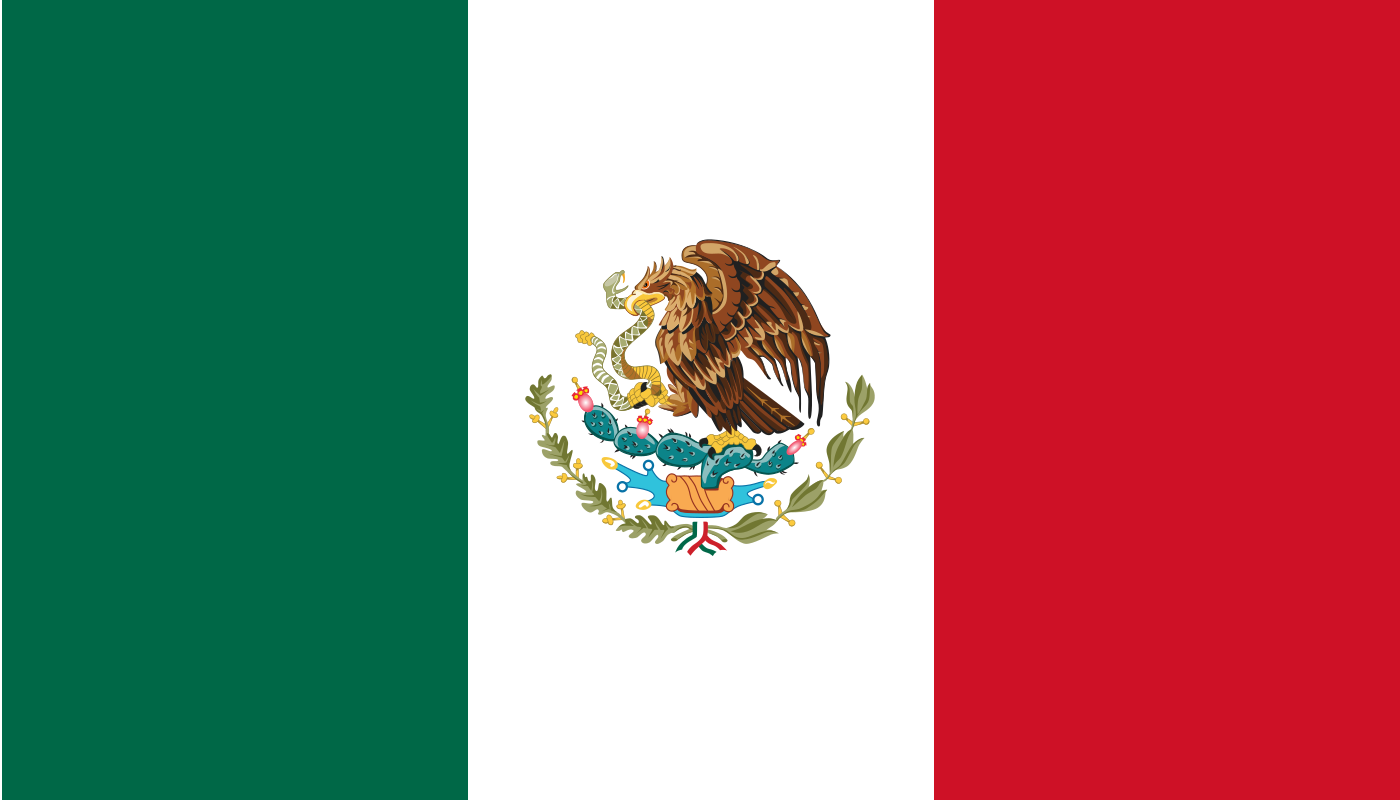
The Mexican national team utilizes a tricolour system, composed of colors Green, White and Red. The team's three colors originate from the national flag of Mexico, known as the tricolor. As of November 2009, the shirt now has 2 red trims on the shirt near the shoulders. Away colors are all black with red and gold trim. The team also designed an all white jersey that celebrates 200 years since Mexico achieved freedom from the Spanish Crown, their independence starting in 1810. Two centuries later, the Mexican Football Association had asked Adidas to design a special home kit that the team would use in 2010. However, an all green kit and an all white kit have been used in the 2010 FIFA World Cup qualifiers. Also, in the 1966 FIFA World Cup the kit consisted of a white shirt with navy blue shorts. In the 1970 FIFA World Cup the away kit was a wine red shirt with navy blue short. An all white kit was also used in the 1998 FIFA World Cup in the group stage games against the Netherlands and Belgium. The Women's team still uses the old kit before November 2009. Socks have usually been red, as to resemble Mexico's flag, but this has been changed to white socks.[13] In current kit, the socks reverted back to red.[14]
Evolution
1928 Home

1930 Away

1950 Home

1954 Home

1958 Home

1962 Home

1962 Away

1966 Home

1966 Away

2006 Home


2006 Away


2007 Home


2007 Away


2008 Home


2008 Away


2010 Home


2010 Away


2010 Bicentennial


Past Crest
-
Used from 1927-75
-
Used from 1975-78
-
Used from 1986-93
Schedule and results
Recent and upcoming games
Date Location Opponent Score1 Competition Scorers for Mexico August 10, 2011 Philadelphia, United States  United States
1–1 F Peralta  17'
17'September 2, 2011 Warsaw, Poland  Poland
1–1 F J. Hernández 34'September 4, 2011 Barcelona, Spain  Chile
Chile1–0 F Guardado 78'October 11, 2011 Torreón, Mexico  Brazil
1–2 F David Luiz 10' (o.g.)November 11, 2011 Querétaro, Mexico  Serbia
2–0 F Salcido 3', J. Hernández 88' (pen.)June 8, 2012 TBD, Mexico  Guyana
WCQ June 12, 2012 TBD, El Salvador  El Salvador
WCQ September 7, 2012 TBD, Costa Rica  Costa Rica
WCQ September 11, 2012 TBD, Mexico Costa RicaWCQ October 12, 2012 TBD, Guyana GuyanaWCQ October 16, 2012 TBD, Mexico El SalvadorWCQ - Key
- F = Friendly
- UF = Unofficial friendly
- WCQ = World Cup Qualifier
- 1.^ Mexico's score is listed first
Current squad
The following 20 players were selected for the friendly game against Serbia.[15] Caps and goals updated as of November 11, 2011.
# Pos. Player Date of Birth (Age) Caps Goals Club 1 GK José de Jesús Corona January 26, 1981 12 0 Cruz Azul12 GK Alfredo Talavera September 18, 1982 9 0 Toluca2 DF Francisco Javier Rodríguez October 20, 1981 65 1  VfB Stuttgart
3 DF Carlos Salcido April 2, 1980 96 7 UANL4 DF Hugo Ayala March 31, 1987 3 0 UANL15 DF Héctor Moreno January 17, 1988 29 0  Espanyol
16 DF Efraín Juárez February 22, 1988 38 1 Zaragoza19 DF Jonny Magallón November 21, 1981 54 3 Guadalajara20 DF Jorge Torres Nilo January 16, 1988 16 1 UANL5 MF Édgar Andrade March 2, 1988 2 0 Chiapas8 MF Israel Castro December 20, 1980 47 1 Cruz Azul11 MF Javier Aquino February 11, 1990 6 0 Cruz Azul13 MF Jesús Zavala July 21, 1987 6 0 Monterrey17 MF Sinha May 23, 1976 55 6 Toluca18 MF Andrés Guardado September 28, 1986 77 13 Deportivo La Coruña21 MF Jesús Molina March 29, 1988 3 0 América7 FW Pablo Barrera June 21, 1987 43 6 Zaragoza9 FW Oribe Peralta January 12, 1984 11 1 Santos Laguna10 FW Giovani dos Santos May 11, 1989 53 11 Tottenham Hotspur14 FW Javier Hernández June 1, 1988 33 23 Manchester UnitedRecent call-ups
The following players have also been called up to the Mexico squad within last 12 months.
Pos. Player Date of Birth (Age) Caps Goals Club Latest Call-up GK Guillermo Ochoa July 13, 1985 47 0  Ajaccio
v. Serbia, November 11, 2011 (withdrew due to injury)GK Luis Ernesto Michel July 21, 1979 10 0 Guadalajara2011 Copa America GK Carlos Felipe Rodríguez April 3, 1989 0 0 Morelia2011 Copa America GK Liborio Sánchez October 9, 1989 0 0 Querétaro2011 Copa America GK Jonathan Orozco May 12, 1986 1 0 Monterrey2011 CONCACAF Gold Cup DF Rafael Márquez February 13, 1979 109 12 New York Red Bullsv. Brazil, October 11, 2011DF Sergio Pérez September 13, 1986 3 0 Monterreyv. Brazil, October 11, 2011DF Édgar Dueñas March 5, 1983 9 0 Tolucav. Chile, September 4, 2011DF Efraín Velarde April 18, 1986 1 0 UNAMv. Chile, September 4, 2011DF Paul Aguilar March 6, 1986 20 2 Américav. United States, August 10, 2011DF Oswaldo Alanís March 18, 1989 0 0 Estudiantes Tecos2011 Copa América DF Kristian Álvarez April 20, 1992 0 0 Guadalajara2011 Copa América DF Néstor Araujo August 29, 1991 5 1 Cruz Azul2011 Copa América DF Dárvin Chávez November 21, 1989 6 0 Monterrey2011 Copa América DF Hiram Mier August 25, 1989 4 0 Monterrey2011 Copa América DF Miguel Ángel Ponce April 12, 1989 2 0 Guadalajara2011 Copa América DF Héctor Reynoso October 3, 1980 4 0 Guadalajara2011 Copa América DF Israel Jiménez August 13, 1989 2 0 UANL2011 Copa América preliminary squad DF Fernando Navarro April 18, 1989 1 0 UANL2011 Copa América preliminary squad DF Néstor Vidrio March 22, 1989 3 0 Atlas2011 Copa América preliminary squad DF Ricardo Osorio March 30, 1980 82 1 Monterrey2011 CONCACAF Gold Cup DF Jorge Iván Estrada October 16, 1983 1 0 Santos Lagunav.  Bosnia and Herzegovina, February 9, 2011
DF Leobardo López September 4, 1983 9 1 Pachucav. Bosnia and Herzegovina, February 9, 2011MF Gerardo Torrado April 30, 1979 135 6 Cruz Azulv. Brazil, October 11, 2011 (withdrew due to injury)MF Adrián Aldrete June 14, 1988 8 0 Moreliav. Chile, September 4, 2011MF Christian Bermúdez April 26, 1987 4 0 Atlantev. Chile, September 4, 2011MF Diego De Buen July 13, 1991 (aged 19) 0 0 UNAM2011 Copa América MF Jorge Enríquez January 8, 1991 5 0 Guadalajara2011 Copa América MF Antonio Gallardo April 19, 1989 0 0 Guadalajara2011 Copa América MF Carlos Orrantía February 1, 1991 0 0 UNAM2011 Copa América MF Édgar Pacheco January 22, 1990 6 1 UANL2011 Copa América MF Diego Reyes September 19, 1992 5 0 América2011 Copa América MF David Cabrera September 7, 1989 3 0 UNAM2011 Copa América preliminary squad MF Néstor Calderón February 14, 1989 5 0 Toluca2011 Copa América preliminary squad MF Jonathan dos Santos April 26, 1990 7 0 Barcelona B2011 Copa América preliminary squad MF Marco Fabián July 21, 1989 3 1 Guadalajara2011 Copa América preliminary squad MF Jorge Hernández June 10, 1989 3 0 Chiapas2011 Copa América preliminary squad MF Luis Ernesto Pérez January 12, 1981 68 8 Monterrey2011 CONCACAF Gold Cup preliminary squad MF José María Cárdenas April 2, 1985 3 1 Santos Lagunav. Bosnia and Herzegovina, February 9, 2011MF Antonio Ríos October 24, 1988 2 0 Tolucav. Bosnia and Herzegovina, February 9, 2011MF Carlos Gerardo Rodríguez April 16, 1985 1 0 Pachucav. Bosnia and Herzegovina, February 9, 2011FW Ángel Reyna September 19, 1984 8 0 Américav. Brazil, October 11, 2011FW Aldo de Nigris July 22, 1983 14 6 Monterreyv. Chile, September 4, 2011FW Omar Arellano June 18, 1987 7 1 Guadalajarav. United States, August 10, 2011FW Ulises Dávila April 13, 1991 (aged 19) 0 0  Vitesse
2011 Copa América FW Rafael Márquez Lugo November 2, 1981 12 0 Morelia2011 Copa América FW Alan Pulido March 8, 1991 0 0 UANL2011 Copa América FW Javier Cortés July 20, 1989 3 0 UNAM2011 Copa América preliminary squad FW Erick Torres January 19, 1993 0 0 Guadalajara2011 Copa América preliminary squad FW Carlos Vela March 1, 1989 35 9 Real Sociedad2011 Copa América preliminary squad FW Elías Hernández April 29, 1988 7 1 Pachuca2011 CONCACAF Gold Cup FW Juan Carlos Cacho May 3, 1982 11 3 UNAMv. Bosnia and Herzegovina, February 9, 2011Previous World Cup squads
- 1930 FIFA World Cup
- 1950 FIFA World Cup
- 1954 FIFA World Cup
- 1958 FIFA World Cup
- 1962 FIFA World Cup
- 1966 FIFA World Cup
- 1970 FIFA World Cup
- 1978 FIFA World Cup
- 1986 FIFA World Cup
- 1994 FIFA World Cup
- 1998 FIFA World Cup
- 2002 FIFA World Cup
- 2006 FIFA World Cup
- 2010 FIFA World Cup
Competitive record
FIFA World Cup record
FIFA World Cup record Year Round Position Pld W D L GF GA  1930
1930Group Stage 13th 3 0 0 3 4 13  1934
1934Did not qualify 1938Withdrew  1950
1950Group stage 12th 3 0 0 3 2 10  1954
1954Group Stage 14th 2 0 0 2 2 8  1958
1958Group Stage 16th 3 0 1 2 1 8 1962Group Stage 11th 3 1 0 2 3 4 1966Group Stage 12th 3 0 2 1 1 3 1970Quarter-Final 6th 4 2 1 1 6 4 1974Did not qualify  1978
1978Group stage 16th 3 0 0 3 2 12 1982Did not qualify 1986Quarter-Final 6th 5 3 2 0 6 2  1990
1990Banned 1994Round of 16 13th 4 1 2 1 4 4 1998Round of 16 13th 4 1 2 1 8 7 
 2002
2002Round of 16 11th 4 2 1 1 4 4 2006Round of 16 15th 4 1 1 2 5 5  2010
2010Round of 16 14th 4 1 1 2 4 5 Total 14/19 49 12 13 24 52 89 FIFA Confederations Cup record
Year Round GP W D* L GS GA  1992
1992Did Not qualify 1995Third-Place 3 1 2 0 4 2 1997Group Stage 3 1 0 2 8 6 1999Champions 5 4 1 0 13 6 2001Group Stage 3 0 0 3 1 8 2003Did Not Qualify 2005Fourth-Place 5 2 2 1 7 6 2009Did Not Qualify 2013Qualified Total 1 Title 19 8 5 6 33 28 CONCACAF Gold Cup record
Year Round GP W D* L GS GA 1963Group Stage 3 1 1 1 9 2 1965Champions 5 4 1 0 13 2  1967
1967Runners-up 5 4 0 1 10 1 1969Fourth-Place 5 1 2 2 4 5  1971
1971Champions 5 4 1 0 6 1  1973
1973Third-Place 5 2 2 1 10 5 1977Champions 5 5 0 0 20 5 1981Third place 5 1 3 1 6 3 1985 Did Not Qualify 1989 Banned 1991Third-Place 5 3 1 1 10 5 1993Champions 5 4 1 0 28 2 1996Champions 4 4 0 0 9 0 1998Champions 4 4 0 0 8 2 2000Quarter-Final 3 1 1 1 6 3 2002Quarter-Final 3 2 1 0 4 1 2003Champions 5 4 1 0 9 0 2005Quarter-Final 4 2 0 2 7 4 2007Runners-up 6 4 0 2 7 5 2009Champions 6 5 1 0 15 2 2011Champions 6 6 0 0 22 4 Total 9 Titles 83 54 17 12 203 52 Copa América record
CONMEBOL Copa América record Year Round Position GP W D* L GS GA  1993
1993Runners-up 2nd 6 2 2 2 8 7 1995Quarter Final 7th 4 1 2 1 5 4  1997
1997Third Place 3rd 6 2 2 2 8 9  1999
1999Third Place 3rd 6 3 1 2 10 9  2001
2001Runners-up 2nd 6 3 1 2 7 5  2004
2004Quarter Final 6th 4 2 1 1 5 7  2007
2007Third Place 3rd 6 4 1 1 13 5  2011
2011Group Stage 12th 3 0 0 3 1 4 Total Runners-up 8/43 38 17 10 11 55 44 Pan American Games record
- 1951 – Did not enter
- 1955 – Silver medal
- 1959 – Sixth place
- 1963 – Did not enter
- 1967 – Gold medal
- 1971 – Round 1
- 1975 – Gold medal
- 1979 – Did not enter
- 1983 – Round 1
- 1987 – Fourth place
- 1991 – Silver medal
- 1995 – Silver medal
- 1999 – Gold medal
- 2003 – Bronze medal
- 2007 – Bronze medal
- 2011 – Gold medal
Central American and Caribbean Games record
- 1935 – Gold Medal
- 1938 – Gold Medal
- 1946 – Did not participate
- 1950 – Round 1
- 1954 – Silver Medal
- 1959 – Gold Medal
- 1962 – Gold Medal
- 1966 – Gold Medal
- 1978 – 4th place
- 1982 – Gold Medal
- 1986 – Gold Medal
- 1990 – Gold Medal
- 1993 – Gold Medal
- 1998 – Gold Medal
- 2002 – Silver Medal
- 2006 – Quarterfinals
Universiade record
- 1979 - Gold Medal
NAFC Championship results
North American Nations Cup results
International Honours
- Copa América: Runner-Up
Regional Honours (CONCACAF)
- CONCACAF Championship: 3
Panamerican Games
- Pan Am Games Gold Medals: 4
Minor Cups
- United States Cup Championship: 3
Player Records
Top 10 goalscorers
Players in bold text are still active with Mexico.
Rank Player Goals Years 1 Jared Borgetti 46 1997–2008 2 Cuauhtémoc Blanco 39 1995– 3 Carlos Hermosillo 35 1984–1997 4 Luis Hernández 35 1995–2002 5 Enrique Borja 31 1966–1975 6 Luis Roberto Alves 30 1988–2001 7 Luis Flores 29 1983–1993 Luis García 1991–1999 Hugo Sánchez 1977–1998 10 Benjamín Galindo 28 1983–1998 Most appearances (caps)
Players in bold text are still active with Mexico. As of 11 October 2011
Rank Player Caps Years 1 Claudio Suárez 178 1992–2006 2 Pável Pardo 148 1996–2009 3 Gerardo Torrado 135 1996– 4 Jorge Campos 131 1991–2004 5 Alberto García-Aspe 127 1988–2002 6 Ramon Ramirez 121 1991–2000 7 Cuauhtémoc Blanco 121 1995– 8 Rafael Márquez 109 1997– 9 Oswaldo Sanchez 99 1996–2011 10 Carlos Hermosillo 97 1984–1997 Goalscorers in World Cups
Player Number of Goals Edition Manuel Rosas 2 1930 Juan Carreño 1 Roberto Gayón Héctor Ortiz 1 1950 Horacio Casarín José Lamadrid 1 1954 Tomás Balcázar Jaime Belmonte 1 1958 Isidoro Díaz 1 1962 Alfredo del Águila Héctor Hernández Enrique Borja 1 1966 Javier Valdivia 2 1970 Javier Fragoso 1 Javier Hernández Gutiérrez Ignacio Basaguren Gustavo Peña José Luis González Player Number of Goals Edition Arturo Vázquez 1 1978 Víctor Rangel Fernando Quirarte 2 1986 Hugo Sánchez 1 Luis Flores Manuel Negrete Raúl Servín Luis García 2 1994 Marcelino Bernal 1 Alberto García Aspe 1 1 1998 Luis Hernández 4 Ricardo Peláez 2 Cuauhtémoc Blanco 1 1 2002 Jared Borgetti 2 Gerardo Torrado 1 Player Number of Goals Edition Omar Bravo 2 2006 Sinha 1 Francisco Fonseca Rafael Márquez 1 1 2010 Javier Hernández 2 Cuauhtémoc Blanco 1 Managers
Manager Career Games managed Won Drawn Lost Win % Adolfo Frías Beltrán1923 6 4 1 1 66.6 Alfonso Rojo de la Vega1928 2 0 2 0 00.0 Juan Luque de Serrallonga1930 3 0 3 0 00.0 Rafael Garza Gutiérrez1934, 1937–1938, 1949 16 14 1 1 87.5 Alfred C. Crowle1935 5 5 0 0 100.0  Jorge Orth
1947 2 2 0 0 100.0 Octavio Vial1950 5 0 4 1 00.0 Antonio López Herranz1950, 1952, 1953–1954, 1956–1958 22 9 10 3 40.9 Horacio Casarín1953 1 1 0 0 100.0 Ignacio Trelles1958, 1960–1969, 1975–1976 106 50 27 29 47.1 Fernando Marcos1959 3 3 0 0 100.0 Arpad Fekete1963 3 1 1 1 33.3 Raúl Cardenas1968, 1969, 1970, 1979–1981 59 25 20 14 42.3 Diego Mercado1969 5 1 2 2 20.0 Javier de la Torre1970–1973 38 20 7 11 52.6 Ignacio Juáregui1974 3 2 1 0 66.6 José Antonio Roca1977–1978 20 11 3 6 55.0 José Moncebáez1979 3 1 1 1 33.3 Gustavo Peña1979 1 1 0 0 100.0  Velibor Milutinović
1983–1986, 1995–1997 104 52 32 20 50.0 Mario Velarde1987–1989 15 13 0 2 86.6 Alberto Guerra1989 3 3 0 0 100.0 Manuel Lapuente1990–1991, 1997–2000 67 33 18 16 49.2 César Luis Menotti1991–1992 19 7 7 5 36.8 Ricardo Ferretti1993 1 1 0 0 100.0 Miguel Mejía Barón1993–1995 54 25 17 12 46.2 Mario Carrillo1999 1 0 0 1 00.0 Gustavo Vargas1999 2 1 1 0 50.0 Enrique Meza2000–2001, 2010 20 5 4 11 25.0 Hugo Sánchez2000, 2006–2008 26 13 4 9 50.0 Javier Aguirre2001–2002, 2009–2010 55 35 10 10 63.6 Ricardo La Volpe2002–2006 71 38 16 17 53.5 Jesús Ramírez2008 5 4 0 1 80.0 Sven-Göran Eriksson2008–2009 13 6 1 6 46.2 Efraín Flores2010 3 1 1 1 33.3 José Manuel de la Torre2010– 16 11 4 1 68.7 As of July 14, 2011.
See also
- Mexico national football team record
- Mexico national football team schedule and results
- Mexico national under-17 football team
- Mexico national under-20 football team
- Mexico national under-22 football team
References
- ^ "FIFA World Rankings". FIFA. http://www.fifa.com/worldfootball/ranking/lastranking/gender=m/fullranking.html. Retrieved 2011-10-19.
- ^ "World Football Elo Ratings". World Football Elo Ratings. http://www.eloratings.net/world.html. Retrieved 2011-6-22.
- ^ a b "The Start; El Comienzo". Televisa. http://www.esmas.com/seleccionmexicana/historia/313563.html. Retrieved 2008-05-01.
- ^ a b c "History of the National football team". Femexfut. http://www.femexfut.org.mx/portalv2/(wor2cn45znbm4tnjnmy11j45)/default.aspx#top. Retrieved 2008-05-01.
- ^ "The First Olympics". Televisa. http://www.esmas.com/seleccionmexicana/historia/313563.html. Retrieved 2008-05-01.
- ^ Match report "Mexico-France Match Report". FIFA. http://fifaworldcup.yahoo.com/06/en/w/pwc/mr_1086.html Match report. Retrieved June 19, 2008.
- ^ "Six countries entered bidding for first World Cup. Hello.". India Times. http://sport.indiatimes.com/soccerarticleshow/1533342.cms. Retrieved May 7, 2007.
- ^ FIFA.com - Antonio Carbajal, el eterno Cinco Copas
- ^ 2002 Fifa World Cup, Japan, Korea Mexico Team Information
- ^ "Five Mexico players suspended for failed drug test". NYTimes.com. Retrieved 9 June 2011.
- ^ "Eight Mexico Players Kicked Off Copa America Team In Prostitution Scandal". ESPN Soccernet. 28 June 2011. http://www.sbnation.com/soccer/2011/6/28/2248761/mexico-copa-america-2011-prostitution-jonathan-dos-santos. Retrieved 28 June 2011.
- ^ www.esmas.com
- ^ Adidas Releases Mexico’s 2010 World Cup Kit - Mexico
- ^ Mexico adidas 2011/12 Home and Away Jerseys / Camisetas | FOOTBALL FASHION.ORG
- ^ "Convocatoria de la Selección Nacional Mayor". http://femexfut.org.mx/portalv2/aspx/WEB_DetalleNoticia.aspx?pnIDNtca=35155.
External links
Football in Mexico Federación Mexicana de Fútbol Asociación National teams MenWomenLeague system MenWomenDomestic cups MenInternationalAwards Footballer of the Year · Top scorersLists All-time Table · Champions · Clubs · International footballers · Foreign players · Venues · El Clásico · Clásico RegiomontanoMen's clubs · Women's clubs · Men's players · Women's players · Expatriate players · Managers · Referees · Venues · Seasons · Records International association football FIFA · World Cup · Confederations Cup · U-20 World Cup · U-17 World Cup · Olympics · Minor tournaments · World Rankings · Player of the Year · FIFA Ballon d'Or · Teams · Debuts · Competitions · Federations · Codes Asia 
Africa North,
Central America
and CaribbeanSouth America Oceania Europe Non-FIFA Games All-Africa Games · Asian Games · CARIFTA Games · East Asian Games · Francophonie Games · IOIG · Lusophony Games · Mediterranean Games · Pan American Games · Pan Arab Games · Pacific Games · South Asian Games · Southeast Asian GamesSee also International women's football. National association football teams of North America, Central America, and the Caribbean (CONCACAF) North America Central America Caribbean Anguilla · Antigua and Barbuda · Aruba · Bahamas · Barbados · Bermuda1 · British Virgin Islands · Cayman Islands · Cuba · Curaçao · Dominica · Dominican Republic · French Guiana2 3 · Grenada · Guadeloupe3 · Guyana2 · Haiti · Jamaica · Martinique3 · Montserrat · Puerto Rico · Saint Kitts and Nevis · Saint Lucia · Saint-Martin3 · Saint Vincent and the Grenadines · Sint Maarten3 · Suriname2 · Trinidad and Tobago · Turks and Caicos Islands · U.S. Virgin IslandsDefunct 1: North American member but affiliated to CFU. · 2: Located in South America but affiliated to CONCACAF and CFU. · 3:Full CONCACAF member, but not affiliated to FIFA. FIFA World Cup Appearances 1930 FIFA World Cup finalists Champions Runners-up Third Fourth Eliminated in the group stage 1950 FIFA World Cup finalists Champions Runners-up Third place Fourth place Eliminated in the first round 1954 FIFA World Cup finalists Champions Runners-up Third place Fourth place Eliminated in the quarter-finals Eliminated in the group stage 1958 FIFA World Cup finalists Champions Runners-up Third place Fourth place Eliminated in the quarter-finals Eliminated in the group stage 1962 FIFA World Cup finalists Champions Runners-up Third place Fourth place Eliminated in the quarter-finals Eliminated in the group stage 1966 FIFA World Cup finalists Champions Runners-up Third place Fourth place Soviet UnionEliminated in the quarter-finals Eliminated in the group stage 1970 FIFA World Cup finalists Champions Runners-up Third place Fourth place Eliminated in the quarter-finals Eliminated in the group stage 1978 FIFA World Cup finalists Champions Runners-up Third place Fourth place Eliminated in the second round Eliminated in the group stage 1986 FIFA World Cup finalists Champions Runners-up Third place Fourth place Eliminated in the quarter-finals Eliminated in the round of 16 Eliminated in the group stage 1994 FIFA World Cup finalists Champions Runners-up Third place Fourth place Eliminated in the quarter-finals Eliminated in the round of 16 Argentina · Belgium · Mexico · Nigeria · Republic of Ireland · Saudi Arabia · Switzerland · United StatesEliminated in the group stage 1998 FIFA World Cup finalists Champions Runners-up Third place Fourth place Eliminated in the quarter-finals Eliminated in the round of 16 Eliminated in the group stage Austria · Belgium · Bulgaria · Cameroon · Colombia · Iran · Jamaica · Japan · Korea Republic · Morocco · Scotland · Saudi Arabia · South Africa · Spain · Tunisia · United States2002 FIFA World Cup finalists Champions Runners-up Third place Fourth place Eliminated in the quarter-finals Eliminated in the round of 16 Eliminated in the group stage 2006 FIFA World Cup finalists Champions Runners-up Third place Fourth place Eliminated in the quarter-finals Eliminated in the round of 16 Eliminated in the group stage Angola · Costa Rica · Côte d'Ivoire · Croatia · Czech Republic · Iran · Japan · Korea Republic · Paraguay · Poland · Saudi Arabia · Serbia & Montenegro · Togo · Trinidad and Tobago · Tunisia · United States2010 FIFA World Cup finalists Champions Runners-up Third place Fourth place Eliminated in the quarterfinals Eliminated in the round of 16 Eliminated in group stage Algeria · Australia · Cameroon · Côte d'Ivoire · Denmark · France · Greece · Honduras · Italy · Korea DPR · New Zealand · Nigeria · Serbia · Slovenia · South Africa · SwitzerlandMexico national football team – Achievements and Awards Achievements Preceded by
1997 BrazilConfederations Cup Champions
1999 (First title)Succeeded by
2001 FrancePreceded by
1963 Costa RicaNorth American Champions
1965 (First title)Succeeded by
1967 GuatemalaPreceded by
1969 Costa RicaNorth American Champions
1971 (Second title)Succeeded by
1973 Haiti
Preceded by
1973 HaitiNorth American Champions
1977 (Third title)Succeeded by
1981 HondurasPreceded by
1991 United StatesNorth American Champions
1993 (Fourth title)
1996 (Fifth title)
1998 (Sixth title)Succeeded by
2000 Canada
Preceded by
2002 United StatesNorth American Champions
2003 (Seventh title)Succeeded by
2005 United StatesPreceded by
2007 United StatesNorth American Champions
2009 (Eighth title)Succeeded by
CurrentPreceded by
1990 CanadaNorth American Champions
(CONCACAF era)
1991 (First title)Succeeded by
DefunctPreceded by
InaguralNorth American Champions
(NAFC era)
1947 (First title)
1949 (Second title)Succeeded by
DefunctCategories:- FIFA Confederations Cup-winning countries
- North American national association football teams
- Mexico national football team
- National sports teams of Mexico













Wikimedia Foundation. 2010.
