

- Max Schmeling
-
For the 2010 German film, see Max Schmeling (film).
Max Schmeling 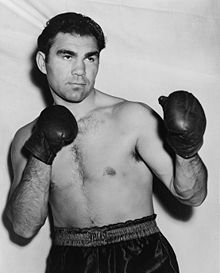
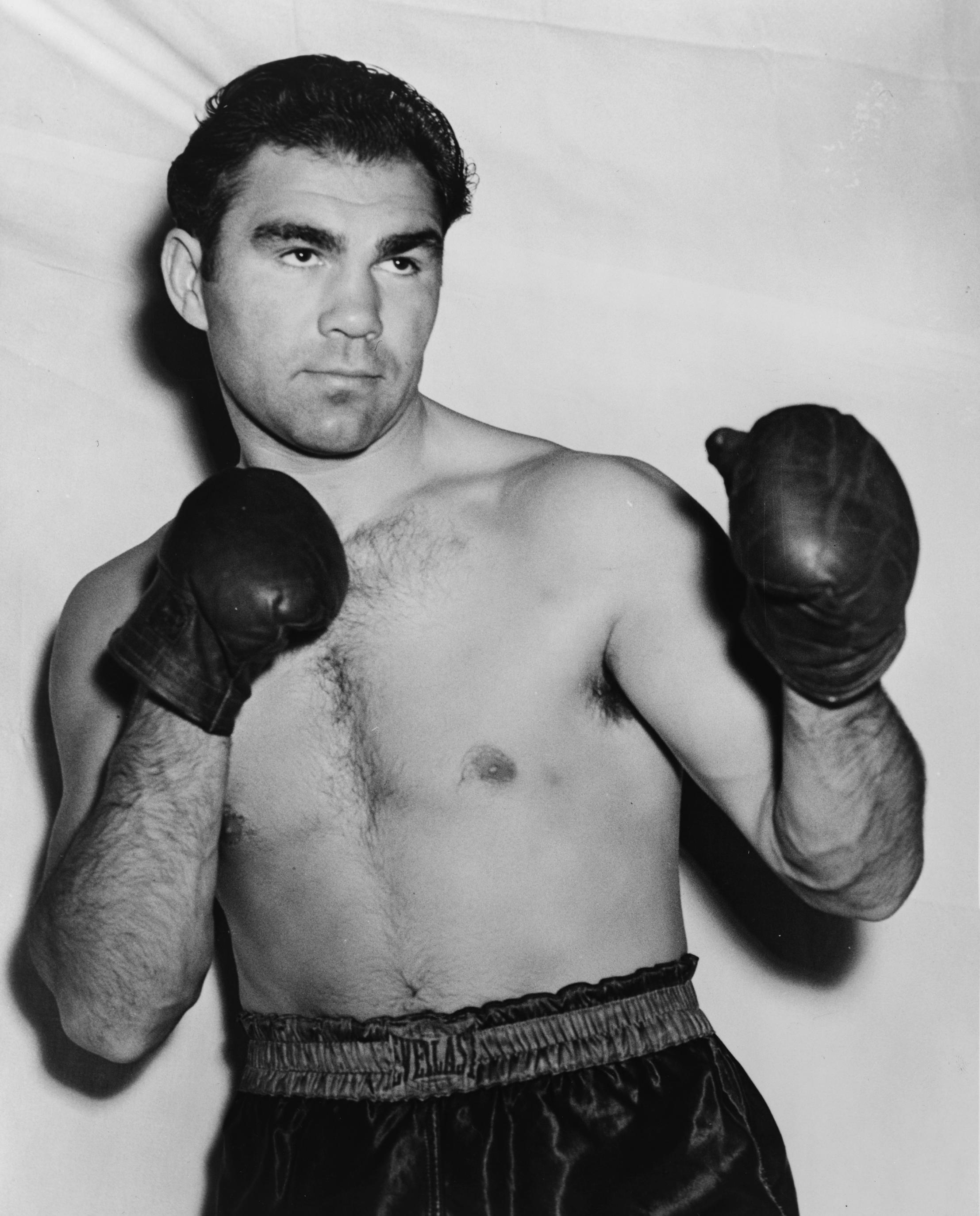
Max Schmeling in 1936Statistics Real name Maximillian Adolph Otto
Siegfried SchmelingNickname(s) Black Uhlan of the Rhine Rated at Heavyweight Height 1.85 m (6 ft 1 in) Reach 193 cm (76 in) Nationality  German
Born September 28, 1905 Died February 2, 2005 (aged 99)
Wenzendorf, GermanyStance Orthodox Boxing record Total fights 70 Wins 56 Wins by KO 40 Losses 10 Draws 4 No contests 0 Maximillian Adolph Otto Siegfried Schmeling (September 28, 1905 – February 2, 2005) was a German boxer who was heavyweight champion of the world between 1930 and 1932. His two fights with Joe Louis in the late 1930s transcended boxing, and became worldwide social events because of their national associations. He was ranked 55 on Ring Magazine's list of 100 greatest punchers of all time.
While Schmeling cooperated with the German government's efforts to play down the increasingly negative international world view of its domestic policies during the 1930s, he was not a member of the Nazi party. In fact, it became known long after the Second World War that Schmeling had risked his own life to save the lives of two Jewish children in 1938.[1]
During World War II, Schmeling served with the German Air Force (Luftwaffe) as an elite paratrooper (Fallschirmjäger).[2]
Contents
Biography
In the USA, he was routinely cast by promoters as the cold-hearted, villainous invader, a puppet of Hitler and a hater of Jews. In Germany, Nazi propagandists portrayed him as a heroic symbol of German destiny and Aryan supremacy. Max Schmeling was none of these things. He was a quality prizefighter with respectable boxing technique, a solid right hand punch, and a keen intellect. The clash of politics, ideals, and countries that often symbolically accompanied his biggest fights only took place within the minds of the audience; they had nothing to do with what happened in the ring. Instead of being respected for his many accomplishments in the ring, he spent much of his life derided in the USA as a Nazi and dismissed in Germany as a disappointment. It was only in his later life that his status as a fighter, divorced from his cultural symbolism, could be clearly analyzed.
Early years
Schmeling first became acquainted with boxing as a teenager, when his father took him to watch film of the heavyweight championship match between Jack Dempsey and Georges Carpentier. Impressed with Dempsey's performance in that fight, young Schmeling became determined to imitate his new hero. He began boxing in amateur competitions and, by 1924, won Germany's national amateur title in the light heavyweight division. Shortly thereafter, he turned professional. Ironically, though he idolized the raging, brawling Dempsey, Schmeling developed a careful, scientific style of fighting that lent itself more to counterpunching. Using this style, he got off to an impressive - though hardly sensational - start by winning seventeen of his first twenty-three bouts, thirteen by knockout. In 1925, he had the thrill of getting into the ring with Dempsey himself, who was then still heavyweight champion of the world, and was touring Europe. Dempsey boxed for two rounds with the then unknown German and, according to a story later told by Schmeling, was greatly impressed. He proved Dempsey's praises correct on August 24, 1926, when picking up the German light heavyweight championship with a first round knockout of rival Max Diekmann, who had previously beaten Schmeling. The next year, Schmeling won the European championship by stopping Fernand Delarge in the first boxing match broadcast live in Germany. After defending both titles against Hein Domgoergen the same year and, in 1928, the European Title with a first round knockout of Michele Bonaglia, he secured the German heavyweight championship with a point victory against Franz Diener, and decided to chase bigger fights and bigger purses in the United States.
Arriving in New York City for the first time in 1928, Schmeling was hardly noticed by the American fight circles. Considered a stiff European fighter who had padded his record against German and European unknowns, he was given few opportunities to prove himself until he hooked up with American manager Joe Jacobs, a man with the proper talents and connections to move Schmeling's career along a positive path. Schmeling's debut in America took place at Madison Square Garden with an eighth round knockout of Joe Monte, who was not a top flight heavyweight but nonetheless a young American who had been in with some tough competition. Two more victories led to a fight with Johnny Risko, one of the biggest names in the division, though somewhat beyond his prime. On February 1, 1929, Schmeling floored Risko four times with his right hand before the referee halted the contest in the ninth round to save Risko from further punishment. The surprised crowd in attendance roared with appreciation and The Ring magazine subsequently recognized the win as its 'Fight of the Year.'
The "Low Blow Champion"
Boxing pundits were quickly changing their opinions of the German. When he defeated the highly-regarded Spaniard Paulino Uzcudun via a fifteen-round decision at Yankee Stadium later that year, Schmeling was suddenly regarded as the foremost young contender in the division. With the Heavyweight World Champion Gene Tunney having recently retired, promoters arranged a matchup between the German and veteran contender Jack Sharkey to fill the vacancy. On June 12, 1930, at Yankee Stadium, in a fight billed as the 'Battle of the Continents,' Schmeling, known as a slow starter, fell slightly behind on points going into the fourth round. Schmeling was trying to corner his opponent when Sharkey let loose with a blow to the body which strayed below the belt line. He immediately clutched his groin and fell to the canvas, claiming to have been fouled. When manager Jacobs ran into the ring, prompting all kinds of chaos, the confused referee disqualified Sharkey and declared Schmeling the victor and the first (and only) man to win the heavyweight championship on a foul. The New York State Athletic Commission (NYSAC), reviewing the call, agreed.
The first European-born boxer to win the heavyweight championship in thirty-three years, Schmeling was also the first from Germany to hold the distinction. Still, the way in which he won the title proved an embarrassment. Called the 'low blow champion,' he was disparaged in both America and Europe as an unproven titleholder. When he initially refused to face Sharkey in a rematch, the NYSAC officially stripped him of their recognition as world champion, but he remained recognized by both the National Boxing Association (NBA) and The Ring magazine. Most of the criticism faded after Schmeling's first defense, an impressive fifteen round TKO over Young Stribling, a future hall-of-famer with 239 wins to his credit by 1931. In order to solidify his title as undisputed, Schmeling signed a contract to face the "Boston Gob" once more. On June 21, 1932, the championship picture became even more muddled when Sharkey won a highly controversial split decision, taking the championship. Many in attendance, including Gene Tunney and the mayor of New York, felt that Schmeling had proven himself the better man and was robbed. In losing the championship, the German had managed to elevate his reputation in the minds of boxing fans.
Walker and Baer
When Schmeling faced Mickey Walker, the future hall-of-famer who had recently held Sharkey to a draw that many felt Walker deserved, it was thought that this fight was for the real heavyweight championship. Walker, a former welterweight, was a popular slugger who had won championships in two divisions but was at a considerable size disadvantage against the European. Though Walker fought bravely and took the lead on points early in the fight, Schmeling showed both boxing ability and punching power in dealing out a terrific beating as the fight progressed. After eight exciting rounds, Walker's corner threw in the towel, confirming Schmeling's status as the leading heavyweight in the world.
With the coming of 1933, however, Schmeling's image in America began to take a decided turn. In 1932, the Nazi Party became the most powerful political force in Germany, and its ideologies, voiced by party leader Adolf Hitler, overflowed with anti-Semitic tendencies. Major American cities such as New York had large Jewish populations, who worried over what the party could mean for people of their religion in the future. Schmeling, because he was German, was viewed as an extension of Hitler's plans for world domination. When Schmeling was slated to fight heavy-hitting contender Max Baer on June 8, 1933, he immediately became the 'bad guy' in the eyes of fans. Baer, who did not practice the Jewish religion but had a Jewish father, came into the ring wearing the Star of David on his shorts. Promoter Jack Dempsey played up this angle and suddenly the fight was viewed as Baer defending his faith against the prejudice of the Nazis, represented reluctantly by Schmeling. Thrown off of his game in part by the bad publicity, but also because of Baer's wild, brawling style and frequent fouls (including backhand punches and rabbit punches), Schmeling was positively thrashed after ten rounds before nearly 60,000 onlookers at Yankee Stadium. While the German took a vicious battering against the ropes in the tenth, the referee leapt in to stop the fight. The embarrassing fight, combined with a follow-up loss to contender Steve Hamas early the next year, left many wondering if Schmeling was still a world top-class fighter.
Dismantling the Bomber
Returning to his native Germany, Schmeling won three of his next four fights, with one draw, including knockout wins over first Walter Neusel, then another redeeming his previous loss to Steve Hamas. His opponents were of an impressive caliber, but many among the American press and fans remained unmoved on the idea of rooting for Schmeling in light of the Nazi Party's behavior. Articles continued to be published declaring the German 'washed up,' a 'has been,' or a 'Nazi puppet.' When he was matched with undefeated African-American sensation Joe Louis in 1936 for the German's first fight on American soil in more than two years, he was clearly the betting underdog, considered a name opponent for Louis to roll over on his route to the title. Nevertheless, he was number two contender for the title behind Louis. Prior to the match, Schmeling carefully studied films of Louis's prior fights, dissecting apparent flaws in the Detroit fighter's technique. Among the weaknesses he noticed was the fact that Louis lowered his left hand after throwing a left jab. In the ring, Schmeling exploited this subtle flaw to his own advantage, countering nearly every Louis jab with his best punch, the right cross. The fight proved to be a competitive, hard-hitting affair for the first three rounds, but, in the fourth, a counter right from the German dropped Louis for the first time in his career. Though Louis rose, he was badly dazed for the remainder of the fight and Schmeling subsequently delivered the finest performance of his career. For a further eight rounds he battered Louis, often standing toe-to-toe with the vaunted puncher and landing that same right hand to the jaw repeatedly. In the twelfth he sent the American tumbling to the floor once more, and this time Louis could not recover. He was counted out on the floor and Schmeling had scored the most talked-about sports upset of the year.
Now the unexpected number one contender for the heavyweight crown held by Jim Braddock, Schmeling looked forward to his chance to regain the title as first Heavyweight ever, scheduled for that September. The fight was postponed, however, when Braddock injured his hand in training. Rumors existed that the fight's organizers were stalling, afraid of the negative publicity that would be generated over a perceived Nazi getting a shot at the world's title. When it was confirmed that Braddock's managers were in talks with the Louis camp, the New York Commission officially released an order for Braddock to fight Schmeling for the title. Any other fight, with Louis or otherwise, would not be recognized by New York as being for the championship. The Madison Square Garden Corporation, the largest promotional company in the sport at the time, even attempted to get a legal injunction against a Braddock-Louis fight (Louis was not on their roster). Nonetheless, in February in 1937, Schmeling received the bad news that the champion had indeed signed to defend his championship against Louis. A furious Schmeling protested, but to no avail, and he was forced to watch from ringside as Louis knocked Braddock out and gained the championship. Sorely disappointed and convinced that he would never receive his chance at redemption, Schmeling fought just once more in America, an eighth round knockout of future contender Harry Thomas, before returning to Germany. In his native land, Schmeling was regarded as a hero and promoted by the Nazi propaganda machine as a perfect example of German supremacy over the rest of the world by virtue of his stunning defeat of the current champion, Louis. The government ordered parades and rallies in his honor. He became a friend to Hitler and other powerful figures in the government and also a popular subject of newspaper articles and films. He continued to press for a chance at a rematch with Louis and in the meantime padded his record against overmatched fighters Ben Foord and Steve Dudas.
"Battle of the Century"
In 1938, champion Joe Louis announced that he would indeed face Schmeling for the title. The rematch became an instant international sensation. Many clamored impatiently for its happening, but others, afraid of international tensions and the possibility of Hitler taking over the championship, protested. The controversy and ballyhoo led to the event becoming the most anticipated boxing match since the rematch between Dempsey and Gene Tunney, or possibly earlier. Louis, with his poor, African-American roots was adopted by American fans as the symbol of America as a land of opportunity. In contrast, Americans perceived Schmeling and his ties to Hitler as an obvious threat to those opportunities and ideals. When the German walked to the ring at Yankee Stadium on June 22, 1938, he did so under a hail of garbage thrown from the stands. Louis came out blazing in the first round and Schmeling tried to counter-punch as he had in the first bout, but to no avail. Driven into the ropes and battered with a fusillade of short, crisp blows from every angle, Schmeling turned his back to his opponent and clutched onto the ropes, letting out a scream that even years later, many spectators could recall vividly. Schmeling would later say that he screamed because he had been hit with a blow to the kidneys. Schmeling's knees buckled under the punishment and referee Arthur Donovan pushed Louis away, beginning a count on Schmeling. Schmeling reluctantly stepped away from the ropes and Donovan allowed him to continue. A few punches later, Schmeling was knocked down again. From then on, he was helpless. He rose but fell moments later and Donovan stopped the fight.
Schmeling in his later years
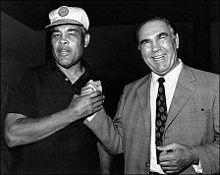 Max Schmeling (right) with Joe Louis in 1971.
When he returned to Germany, Schmeling was now shunned by the Nazis. He managed to win both the German and European heavyweight championships on the same night, with a first round knockout of Adolf Heuser. During the Nazi purge of Jews from Berlin, he personally saved the lives of two Jewish children by hiding them in his apartment. During the war, Schmeling participated in the 1941 Battle of Crete, where he was wounded and after recovery was dismissed from active service. He later visited American P.O.W. camps and occasionally tried to help conditions for the prisoners. After the war, strapped for money, he embarked upon a moderately successful comeback in boxing, winning three of his five bouts with two point defeats before re-entering retirement in 1948.
During the 1950s, Schmeling began working for the Coca-Cola Company's offices in Germany. Before long he owned his own bottling plant and held an executive's position within the company. He became friends with Joe Louis and assisted his former rival financially in his later years, eventually financing his military funeral in 1981.
His wife for 54 years, the Czech-born actress Anny Ondra died in 1987. In 1992, he was inducted into the International Boxing Hall of Fame. He lived his remaining years as a wealthy man and avid boxing fan, dying on February 2, 2005 at the age of 99.
Honours
- German Lightheavyweight Champion 1926 - 1928
- European Lightheavyweight Champion 1927 - 1928
- German Heavyweight Champion 1928
- World Heavyweight Champion 1930 - 1932
- European Heavyweight Champion 1939 - 1943
Cultural references
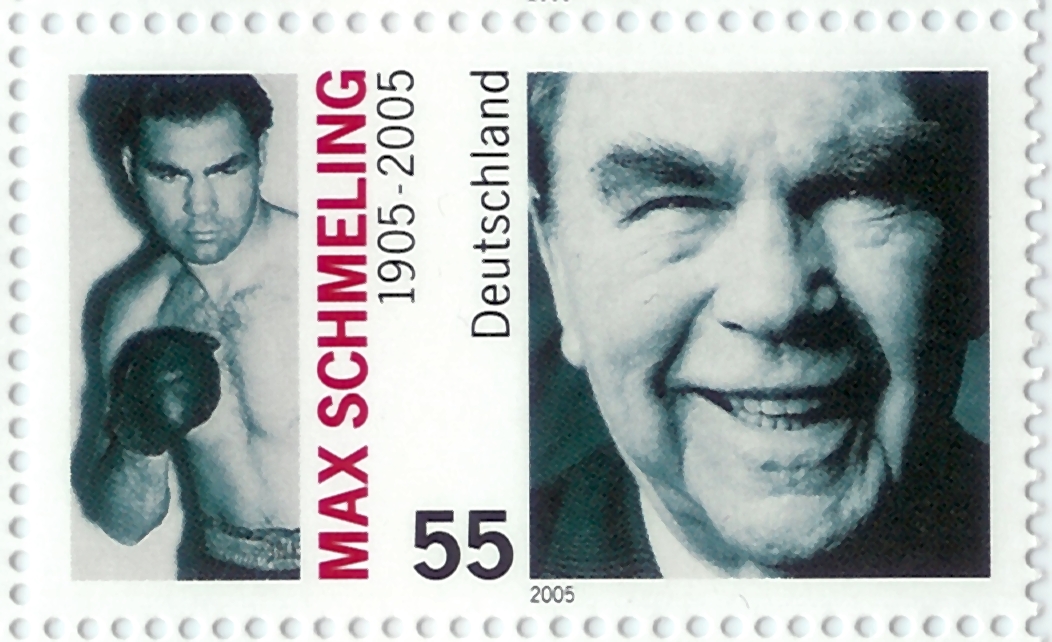
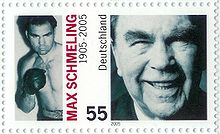 German stamp, 2005
Schmeling lived in Stettin, Germany (now known as Szczecin, Poland); a band from this city, The Analogs, recorded the song "Max Schmeling" on their album Hlaskover rock.
In his movie "Deconstructing Harry" [1997] Woody Allen is playing the character of Harry Block who claims to have divorced his first wife since "she looked like Max Schmeling" under a particular lighting setting.
The 2002 film Joe and Max - Rivalen im Ring tell the true story of Joe Louis and Max Schmeling and their enduring friendship.
In the book The Amazing Adventures of Kavalier and Clay, Joe Kavalier is beaten up by someone who may or may not have been Max Schmeling. The author hints that it probably wasn't, as Schmeling should have been fighting in Poland at the time.
The basketball arena in Berlin that the basketball team Alba Berlin used (Max-Schmeling-Halle) is named in honor of the legendary fighter.
The song "Ambling Alp" by Yeasayer mentions Max Schmelling as a "formidable foe." The nicknake 'Ambling Alp' does not refer to Schmelling but refers to another contemporary boxer Primo Carnera. Carnera and Schmeling never faced each other in the ring, but both had high-profile bouts with Joe Louis.
Schmeling also appears as a character in the opera, Shadowboxer, based on the life of Joe Louis.[3]
Schmeling figures prominently in the 2010 novel by P.F. Kluge A Call From Jersey.[1]
Residencies
Schmeling lived for many years in a mansion on Schweinfurth Strasse in the leafy green suburb of Dahlem in Berlin. The house currently houses the Libyan embassy.
Honorary Residencies
- Honorary Resident of the City of Los Angeles
- Honorary Resident of Las Vegas
- Honorary Resident of Klein-Luckow (his hometown)
- Honorary Member of the Austrian Boxing Federation
Professional Record
56 Wins (40 knockouts, 16 decisions), 10 Losses (5 knockouts, 5 decisions), 4 Draws [2] Result Record Opponent Type Round Date Location Notes Loss 56-10-4 Richard VogtPTS 10 31/10/1948 Waldbuehne, Westend, Berlin, GermanyWin 56-9-4 Hans Joachim DraegesteinTKO 9 (10) 02/10/1948 VFB Platz, Kiel, Schleswig-Holstein, GermanyDraegestein suffered broken jaw. Loss 55-9-4 Walter NeuselPTS 10 23/05/1948 Platz in Hamburg-Altona, Altona, Hamburg, GermanyWin 55-8-4 Hans Joachim DraegesteinPTS 10 07/12/1947 Omnibushalle, Altona, Hamburg, GermanyWin 54-8-4 Werner VollmerKO 7 (10) 28/09/1947 Waldstadion, Frankfurt, Hessen, GermanyThis was Schmeling's first fight in over eight years. Win 53-8-4  Adolf Heuser
KO 1 (15) 02/07/1939 Adolf-Hitler-Kampfbahn, Stuttgart, Baden-Württemberg, GermanyWon EBU & Germany BDB Heavyweight titles. The fight has the largest boxing audience in German boxing history of 70,000 people. Loss 52-8-4  Joe Louis
KO 1 (15) 22/06/1938 Yankee Stadium, Bronx, New York, United StatesFor NYSAC, NBA & World Heavyweight titles. Proclaimed the "Fight of the Decade" by The Ring Magazine. Win 52-7-4 Steve DudasKO 5 (?) 16/04/1938 Hanseatenhalle, Hamburg, GermanyWin 51-7-4  Ben Foord
PTS 12 30/01/1938 Hanseatenhalle, Hamburg, GermanyWin 50-7-4 Henry ThomasTKO 8 (15) 13/12/1937 Madison Square Garden, New York, New York, United StatesWin 49-7-4 Joe LouisKO 12 (15) 19/06/1936 Yankee Stadium, Bronx, New York, United StatesLouis was down in the 4th and 12th rounds. 1936 Fight of the Year by The Ring Magazine. Win 48-7-4  Paulino Uzcudun
PTS 12 07/07/1935 Poststadion, Moabit, Berlin, GermanyWin 47-7-4 Steve HamasKO 9 (12) 10/03/1935 Hanseatenhalle, Hamburg, GermanyWin 46-7-4 Walter NeuselKO 9 (15) 26/08/1934 Sandbahn Lokstedt, Hamburg, GermanyThis fight has the largest European boxing attendance of 102,000 people. Draw 45-7-4 Paulino UzcudunPTS 12 13/05/1934 Montjuich Stadium, Barcelona, Cataluña, SpainLoss 45-7-3 Steve HamasPTS 12 13/02/1934 Convention Hall, Philadelphia, Pennsylvania, United StatesLoss 45-6-3 Max BaerTKO 10 (15) 08/06/1933 Yankee Stadium, Bronx, New York, United StatesThe fight was in front of a crowd of 53,000 (with another 3,300 with passes). Including Jack Sharkey and Primo Carnera, paid $239,676.07 to assure a fair profit for Jack Dempsey in his first big promotional venture. 1933 Fight of the Year by The Ring Magazine. Win 45-5-3 Mickey WalkerTKO 8 (15) 26/09/1932 Madison Square Garden Bowl, Long Island City, Queens, New York, United StatesWalker down once in round 1 and twice in round 8. Jack Kearns, Walker's manager, signaled Referee Denning to stop the bout. Loss 44-5-3 Jack SharkeySD 15 21/06/1932 Madison Square Garden Bowl, Long Island City, Queens, New York, United StatesLost NYSAC & NBA Heavyweight titles. As a result of the controversial decision of this bout, the NYSAC barred any but "boxing experts" (sports writers, referees, judges) from broadcasting descriptions of future matches. Win 44-4-3 Young StriblingTKO 15 (15) 03/07/1931 Municipal Stadium, Cleveland, Ohio, United StatesRetained NBA & World Heavyweight titles. 1931 Fight of the Year by The Ring Magazine. Win 43-4-3 Jack SharkeyDQ 4 (15) 12/06/1930 Yankee Stadium, Bronx, New York, United StatesWon vacant NYSAC & NBA Heavyweight titles. Sharkey was disqualified because of a low blow. Win 42-4-3 Paulino UzcudunPTS 15 27/06/1929 Yankee Stadium, Bronx, New York, United StatesSchmeling injured his right hand in the 5th round. Win 41-4-3 Johnny RiskoTKO 9 (15) 01/02/1929 Madison Square Garden, New York, New York, United States1929 Fight of the Year by The Ring Magazine. Schmeling dropped Risko in rounds 1, 7, 8, and 9, each time with a right hand. Win 40-4-3  Pietro Corri
KO 1 (10) 21/01/1929 Laurel Garden, Newark, New Jersey, United StatesWin 39-4-3 Joe SekyraPTS 10 04/01/1929 Madison Square Garden, New York, New York, United StatesWin 38-4-3 Joe MonteKO 8 (10) 23/11/1928 Madison Square Garden, New York, New York, United StatesWin 37-4-3 Franz DienerPTS 15 04/04/1928 Sportpalast, Schoeneberg, Berlin, GermanyRetained Germany BDB Light Heavyweight title. Win 36-4-3 Ted MoorePTS 10 11/03/1928 Dortmund, Nordrhein-Westfalen, GermanyLoss 35-4-3  Gipsy Daniels
KO 1 (10) 25/02/1928 Frankfurt, Hessen, GermanyWin 35-3-3  Michele Bonaglia
KO 1 (15) 06/01/1928 Sportpalast, Schoeneberg, Berlin, GermanyRetained EBU Light Heavyweight title. Win 34-3-3 Gipsy DanielsPTS 10 02/12/1927 Sportpalast, Schoeneberg, Berlin, GermanyWin 33-3-3 Hein DomgoergenKO 7 (15) 06/11/1927 Leipzig, Sachsen, GermanyRetained EBU & Germany BDB Light Heavyweight titles. Win 32-3-3  Louis Clement
KO 6 (?) 02/10/1927 Dortmund, Nordrhein-Westfalen, GermanyWin 31-3-3  Robert Larsen
KO 3 (?) 02/09/1927 Sportpalast, Schoeneberg, Berlin, GermanyWin 30-3-3  Willem Westbroek
KO 3 (?) 07/08/1927 Radrennbahn, Essen, Nordrhein-Westfalen, GermanyWin 29-3-3 Jack TaylorPTS 10 13/07/1927 Hamburg, GermanyWin 28-3-3  Fernand Delarge
KO 14 (15) 19/06/1927 Westfalenhallen, Dortmund, Nordrhein-Westfalen, GermanyRetained EBU Light Heavyweight title. Win 27-3-3  Raoul Paillaux
KO 3 (?) 17/05/1927 Frankfurt, Hessen, GermanyWin 26-3-3 Robert LarsenPTS 10 07/05/1927 Frankfurt, Hessen, GermanyWin 25-3-3 Stanley GlenKO 1 (?) 26/04/1927 Sagebiel, Hamburg, GermanyWin 24-3-3 Francois CharlesKO 8 (?) 08/04/1927 Berlin, GermanyWin 23-3-3 Leon SebiloKO 2 (?) 12/03/1927 Dortmund, Nordrhein-Westfalen, GermanyWin 22-3-3 Joe MehlingKO 3 (?) 04/02/1927 Zirkus Sarassani, Dresden, Sachsen, GermanyWin 21-3-3 Louis WilmsTKO 8 (?) 23/01/1927 Jahrhunderthalle, Breslau, Lower Silesia, Germany (now Wrocław, Poland)Win 20-3-3 Jack StanleyKO 8 (?) 07/01/1927 Sportpalast, Schoeneberg, Berlin, GermanyWin 19-3-3 Herman van't HofDQ 8 (?) 01/10/1926 Sportpalast, Schoeneberg, Berlin, GermanyVan 't Hof was disqualified for kidney-punching. Win 18-3-3 Max DiekmannKO 1 (12) 24/08/1926 Berlin, GermanyWon Germany BDB Light Heavyweight title. Win 17-3-3 August VongehrTKO 1 (4) 13/07/1926 Luna Park, Berlin, Halensee, Berlin, GermanyWin 16-3-3 Willy LouisTKO 1 (?) 19/03/1926 Cologne, Nordrhein-Westfalen, GermanyDraw 15-3-3 Max DiekmannPTS 8 12/02/1926 Berlin, GermanyWin 15-3-2 Rene ComperePTS 8 08/11/1925 Cologne, Nordrhein-Westfalen, GermanyLoss 14-3-2  Larry Gains
TKO 2 (?) 01/09/1925 Cologne, Nordrhein-Westfalen, GermanyDraw 14-2-2 Leon RandolPTS 10 13/06/1925 Brussels, BelgiumLoss 14-2-1 Jack TaylorPTS 10 09/05/1925 Cologne, Nordrhein-Westfalen, GermanyWin 14-1-1 Fred HammerPTS 8 28/04/1925 Bonn, Nordrhein-Westfalen, GermanyDraw 13-1-1 Jimmy LyggettPTS 8 03/04/1925 Berlin, GermanyWin 13–1  Alfred Baker
KO 3 (?) 15/03/1925 Cologne, Nordrhein-Westfalen, GermanyWin 12–1 Leon RandolKO 4 (?) 01/03/1925 Cologne, Nordrhein-Westfalen, GermanyWin 11–1 Joe MehlingPTS 6 20/01/1925 Berlin, GermanyWin 10–1 Johnny CludtsKO 2 (?) 18/01/1925 Schauburgring, Cologne, Nordrhein-Westfalen, GermanyWin 9–1 Jimmy Lyggett SrTKO 4 (?) 26/12/1924 Cologne, Nordrhein-Westfalen, GermanyWin 8–1 Helmuth HartigKO 1 (?) 17/12/1924 Berlin, GermanyWin 7–1 Battling MatharKO 3 (?) 07/12/1924 Westfalenhalle, Düsseldorf, Nordrhein-Westfalen, GermanyWin 6–1 Hans BreuerKO 2 (?) 04/12/1924 Cologne, Nordrhein-Westfalen, GermanyWin 5–1 Fred HammerKO 3 (?) 31/10/1924 Westdeutsche Sporthalle, Cologne, Nordrhein-Westfalen, GermanyLoss 4–1 Max DiekmannTKO 4 (?) 10/10/1924 Sportpalast, Schoeneberg, Berlin, GermanyWin 4–0 Rocky KnightPTS 8 04/10/1924 Cologne, Nordrhein-Westfalen, GermanyWin 3–0 Henri van der VyverKO 3 (?) 22/09/1924 Düsseldorf, Nordrhein-Westfalen, GermanyWin 2–0 Willy LouisKO 1 (?) 20/09/1924 Duisburg, Nordrhein-Westfalen, GermanyWin 1–0 Hans CzappKO 6 (?) 02/08/1924 Tonhalle, Duisburg, Nordrhein-Westfalen, GermanyPro debut for Schmeling. See also
- List of heavyweight boxing champions
- List of European Boxing Union heavyweight champions
References
- ^ "Max Schmeling - Auschwitz.dk". http://www.auschwitz.dk/schmeling.htm. Retrieved 2008-06-11.
- ^ "Max Schmeling - NNDB.com". http://www.nndb.com/people/245/000027164/. Retrieved 2008-06-11.
- ^ Midegette, Anne, "Inspired by Joe Louis, opera 'Shadowboxer' scores one for reality", Washington Post, 17 April 2010
External links
- East Side Boxing article on Max Schmeling
- 'The Mirror and Max Schmeling,' obituary (American Spectator)
- Professional boxing record for Max Schmeling from BoxRec
- Max Schmeling at Find a Grave
- PBS biography of Max Schmeling
- BBC obituary for Max Schmeling
- NPR memorial (with audio)
- The Fight of the Century NPR special on the selection of the radio broadcast to the 2005 National Recording Registry
- Max Schmeling on the Hindenburg
Achievements Preceded by
Gene Tunney
RetiredNYSAC Heavyweight Champion
June 12 1930 – January 7 1931
StrippedSucceeded by
Jack SharkeyNBA Heavyweight Champion
June 12 1930 – June 21 1932Sporting positions Preceded by
Jack SharkeyOldest Living Heavyweight Champion
August 17 1994 - February 2 2005Succeeded by
Ingemar JohanssonCategories:- 1905 births
- 2005 deaths
- People from Vorpommern-Greifswald
- German World War II Fallschirmjäger
- German boxers
- Heavyweight boxers
- International Boxing Hall of Fame inductees
- Jack Dempsey
- People from the Province of Pomerania
- Commanders Crosses of the Order of Merit of the Federal Republic of Germany
- World Boxing Association Champions
- World heavyweight boxing champions













Wikimedia Foundation. 2010.
