

- Parliamentary Assembly of the Council of Europe
-
Not to be confused with European Parliament or Assembly of the Western European Union.
 The emblem of the PACE
The Parliamentary Assembly of the Council of Europe (PACE), which held its first session in Strasbourg on 10 August 1949, can be considered the oldest international parliamentary assembly with a pluralistic composition of democratically elected members of parliament established on the basis of an intergovernmental treaty. The Assembly is one of the two statutory organs of the Council of Europe, which is composed of the Committee of Ministers (the Ministers of Foreign Affairs, meeting usually at the level of their deputies) and the Assembly representing the political forces (majority and opposition) in its member states.
Contents
Functions
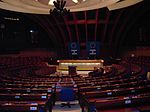
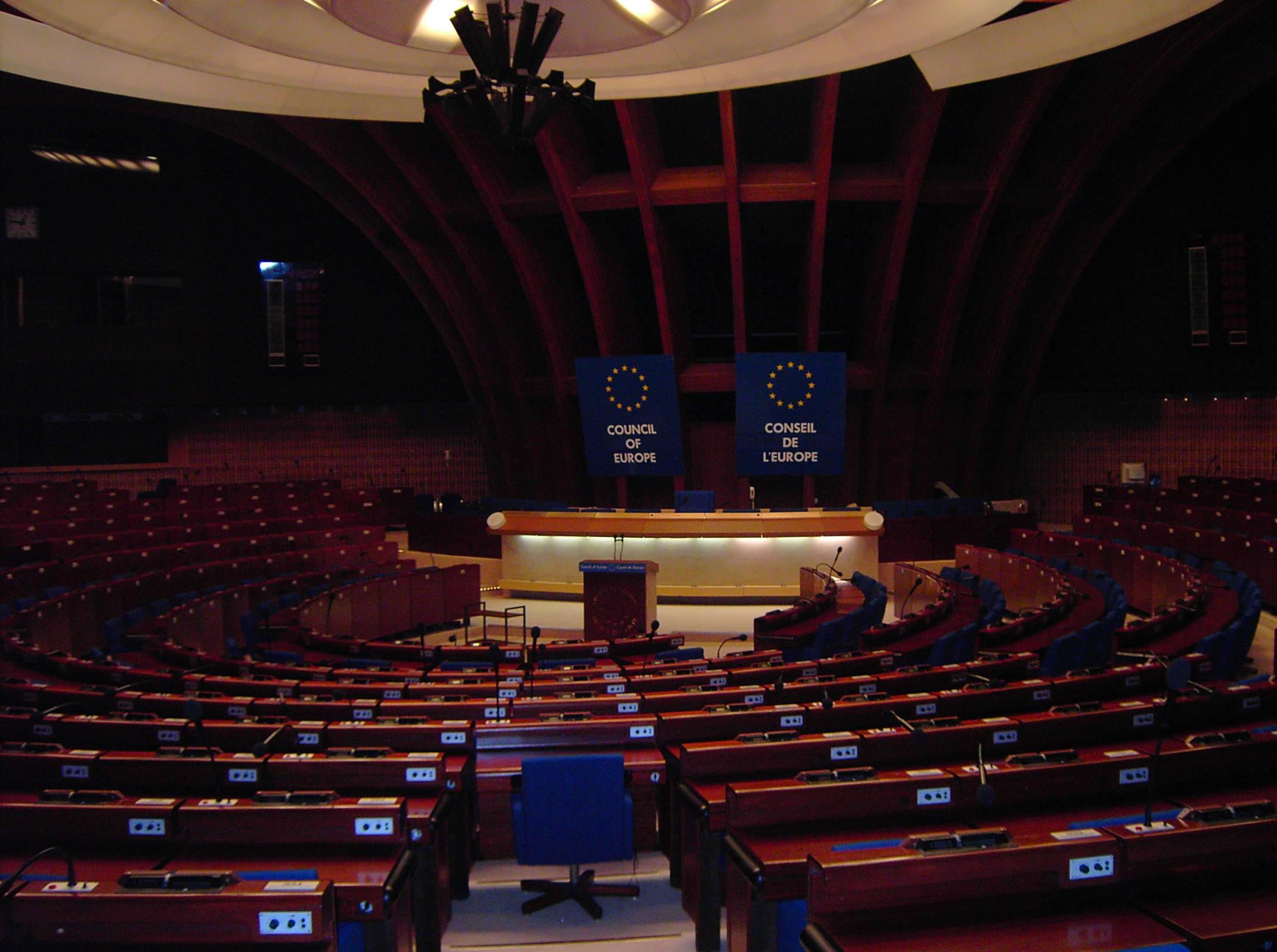
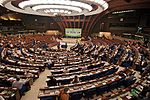 The hemicycle of the PACE at the Palace of Europe
Unlike the European Parliament (an institution of the European Union), which was created after the model of the PACE and also meets in Strasbourg for its plenary sessions (prior to 1999, in the PACE hemicycle), its powers extend only to the ability to investigate, recommend and advise. Even so, its recommendations on issues such as human rights have significant weight in the European political context. The European Parliament and other European Union institutions often refer to the work of PACE, especially in the field of human rights, legal co-operation and cultural co-operation.
Important statutory functions of the PACE are the election of the Secretary General of the Council of Europe, the judges of the European Court of Human Rights and the members of the European Committee for the Prevention of Torture.
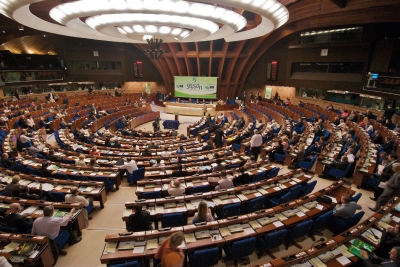
In general it meets 4 times per year at Strasbourg at the Palace of Europe for a week. The 10 permanent commissions of the Assembly meet all year long to prepare reports and projects for resolutions in their respective fields of expertise.
The Assembly sets its own agenda. It discusses European and international events and examines current subjects which interest the populations of the countries of Europe. The main themes covered are human rights, democracy, protection of minorities and the rule of law.
Members
It has a total of 642 members – 321 principal members and 321 substitutes [1] - who are representatives of each member state. There are also 18 delegates from the Canadian, Israeli and Mexican observers. The size of each country determines its number of representatives and number of votes. This is in contrast in the committee of ministers, where each country has one vote.
Each State member selects its method of designating its representatives to the parliamentary assembly; however, they must be chosen from among the members of the respective Parliaments. Moreover, the political composition of each national delegation must reflect the representation of the different parties within the respective parliaments.
Some notable members of PACE include:
- Dick Marty (Switzerland), appointed in late 2005 as rapporteur to investigate the CIA extraordinary renditions scandal and Organ theft in Kosovo by the terrorist Kosovo Liberation Army from the Kosovo war, in 1998-2001[2]
- Marcello Dell'Utri (Italy), convicted for complicity in conspiracy with the Mafia (Italian: concorso in associazione mafiosa), a crime for which he was found guilty on appeal and sentenced to 7 years in 2010.[3]
Composition by country
Country Seats Accession date  Albania
4 1995  Andorra
2 1994  Armenia
4 2001  Austria
6 1956  Azerbaijan
6 2001  Belgium
7 1949  Bosnia and Herzegovina
5 2002  Bulgaria
6 1992  Croatia
5 1996  Cyprus
3 1961  Czech Republic
7 1991  Denmark
5 1949  Estonia
3 1993  Finland
5 1989  France
18 1949  Georgia
5 1999  Germany
18 1951  Greece
7 1949  Hungary
7 1990  Iceland
3 1959  Ireland
4 1949  Italy
Italy18 1949  Latvia
3 1995  Liechtenstein
2 1978  Lithuania
4 1993  Luxembourg
3 1949  Macedonia
3 1995  Malta
Malta3 1965  Moldova
5 1995  Monaco
2 2004  Montenegro
3 2007[4]  Netherlands
7 1949  Norway
5 1949  Poland
12 1991  Portugal
7 1976  Romania
10 1993  Russia
18 1996  San Marino
2 1988  Serbia
7 2003  Slovakia
5 1993[5]  Slovenia
3 1993  Spain
Spain12 1977  Sweden
6 1949  Switzerland
6 1963  Turkey
12 1949  Ukraine
12 1995  United Kingdom
18 1949 Countries with observer status
Country Seats Date  Canada
6 1996[6]  Israel
3 ?  Mexico
? 1999  Northern Cyprus as "Turkish Cypriot Community"
2 2004[7] Canada (1996), Holy See (1970), Israel, Japan (1996), Mexico (1999), Turkish Cypriot Community (2004) and United States (1995) have observer status [8].
The special guest status of Belarus was suspended on 13 January 1997.
Composition by party groups
The assembly has five political groups.
Group Ideology Chairman Members European People's Party Christian democracy, liberal conservatism Luca Volontè 218 Socialist Group Social democracy, democratic socialism Andreas Gross 206 European Democrat Group Conservatism Robert Walter 115 Alliance of Liberals and Democrats for Europe Liberalism Anne Brasseur 103 Group of the Unified European Left Democratic socialism, communism Tiny Kox 31 Languages
The official languages of the council of Europe are English and French, but the assembly also uses German and Italian as working languages. At the plenary sessions (which last one week and take place four times per year), the available languages are English, French, German, Italian, Russian, Greek and Spanish, for which there are interpreters. Each member of Parliament has individual headphones and a controller for him to chose the desired language. Foreign guests who speak another language must either express themselves in one of the two official languages, or bring their own interpreter. In spite of this seemingly idealistic and relatively expensive operation, it appears that the majority of the interventions in the assembly are done in English.[citation needed]
Presidents
The presidents of the Parliamentary Assembly of the Council of Europe have been :
The Secretary General of the Assembly is Mateo Sorinas (Spain) since 1 February 2006.
See also
References
- ^ This number is fixed by article 26.
- ^ https://wcd.coe.int/wcd/ViewDoc.jsp?Ref=PR968%282010%29&Language=lanEnglish&Ver=original&Site=DC&BackColorInternet=F5CA75&BackColorIntranet=F5CA75&BackColorLogged=A9BACE
- ^ (Italian) [1]
- ^ previously part of Serbia and Montenegro: member since 2003
- ^ Previously part of Czechoslovakia, member since 1991
- ^ [2]
- ^ Resolution 1376 (2004) Parliamentary Assembly of the Council of Europe
- ^ [3]
Further reading
- (French) Le Conseil de l'Europe, Jean-Louis Burban, publisher PUF, collection « Que sais-je ? », n° 885.
External links
Council of Europe Institutions - Secretary General
- Committee of Ministers
- Parliamentary Assembly
- Congress
- Court of Human Rights
- Commissioner for Human Rights
- Commission for the Efficiency of Justice
- Commission against Racism and Intolerance
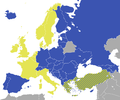
Members 1 Provisionally referred to by the Council of Europe as "the former Yugoslav Republic of Macedonia"; see Macedonia naming dispute.Categories:- Parliamentary Assembly of the Council of Europe
- Politics of Europe
- International organizations of Europe
- Strasbourg








Wikimedia Foundation. 2010.
