

- Chain (algebraic topology)
-
This article is about algebraic topology. For the term chain in order theory, see chain (order theory).
In algebraic topology, a simplicial k-chain is a formal linear combination of k-simplices.[1]
Integration on chains
Integration is defined on chains by taking the linear combination of integrals over the simplices in the chain with coefficients typically integers. The set of all k-chains forms a group and the sequence of these groups is called a chain complex.
Boundary operator on chains
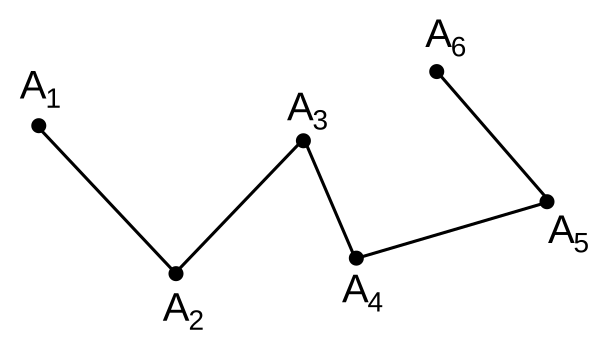
 The boundary of a polygonal curve is a linear combination of its nodes; in this case, some linear combination of A1 through A6. Assuming the segments all are oriented left-to-right (in increasing order from Ak to Ak+1), the boundary is A6 − A1.
 A closed polygonal curve, assuming consistent orientation, has null boundary.
The boundary of a chain is the linear combination of boundaries of the simplices in the chain. The boundary of a k-chain is a (k−1)-chain. Note that the boundary of a simplex is not a simplex, but a chain with coefficients 1 or −1 – thus chains are the closure of simplices under the boundary operator.
Example 1: The boundary of a path is the formal difference of its endpoints: it is a telescoping sum. To illustrate, if the 1-chain
 is a path from point
  to point
  , where
 ![t_1=[v_1, v_2]\,](e/b6e7d3ecaef478651e0d87ae5d7079ad.png) ,
, ![t_2=[v_2, v_3]\,](e/5ee705b1ad0e6ff83958b377a9ae1e89.png) and
and ![t_3=[v_3, v_4]\,](1/09108c28ba3db9561bd3366c94efc7e7.png) are its constituent 1-simplices, then
are its constituent 1-simplices, thenExample 2: The boundary of the triangle is a formal sum of its edges with signs arranged to make the traversal of the boundary counterclockwise.
A chain is called a cycle when its boundary is zero. A chain that is the boundary of another chain is called a boundary. Boundaries are cycles, so chains form a chain complex, whose homology groups (cycles modulo boundaries) are called simplicial homology groups.
Example 3: A 0-cycle is a linear combination of points such that the sum of all the coefficients is 0. Thus, the 0-homology group measures the number of path connected components of the space.
Example 4: The plane punctured at the origin has nontrivial 1-homology group since the unit circle is a cycle, but not a boundary.
In differential geometry, the duality between the boundary operator on chains and the exterior derivative is expressed by the general Stokes' theorem.
References
- ^ Hatcher, Allen (2002). Algebraic Topology. Cambridge University Press. ISBN 0-521-79540-0. http://www.math.cornell.edu/~hatcher/AT/ATpage.html.
Categories:- Algebraic topology
- Integration on manifolds

![\begin{align}
\partial_1 c
&= \partial_1(t_1 + t_2 + t_3)\\
&= \partial_1(t_1) + \partial_1(t_2) + \partial_1(t_3)\\
&= \partial_1([v_1, v_2]) + \partial_1([v_2, v_3]) + \partial_1([v_3, v_4]) \\
&= ([v_2]-[v_1]) + ([v_3]-[v_2]) + ([v_4]-[v_3]) \\
&= [v_4]-[v_1].
\end{align}](3/183536d07b946501af8c58b1b8d1d63d.png)
Wikimedia Foundation. 2010.
